

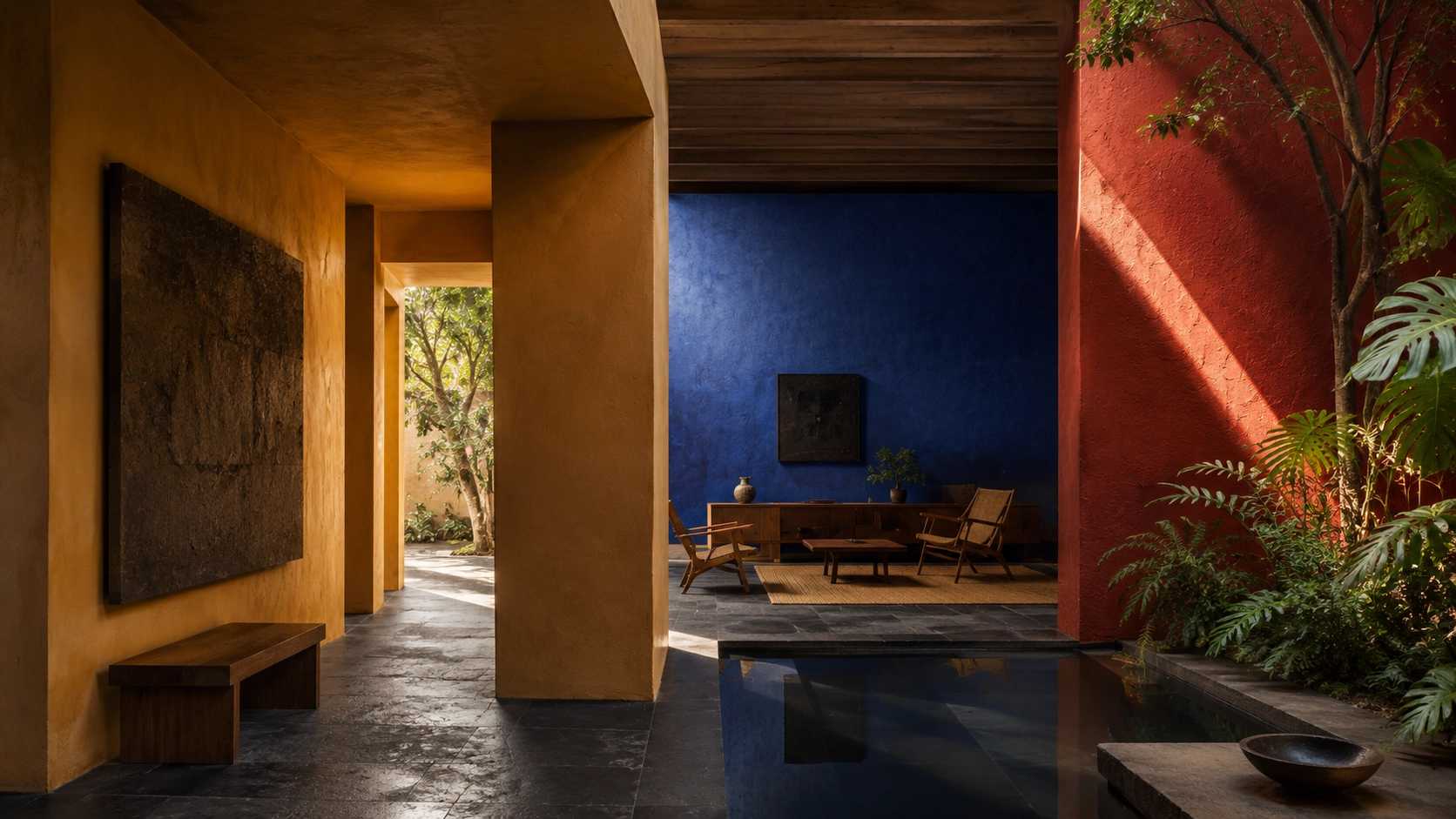
At Casa Gilardi, the color arrives before the room fully reveals itself. A narrow corridor glows yellow, guiding the eye toward a dining space where a saturated blue wall meets a plane of red beside an indoor pool. Light enters from above, strikes the water, and turns the architecture into something almost weightless.
Luis Barragán designed the house late in his career, yet it contains many of the ideas that made his work so enduring: silence, enclosure, shadow, unexpected color, and an instinctive understanding of how a person moves through space. The residence remains privately owned and can be visited only by advance reservation, preserving the unusual intimacy of encountering modern architecture in a home that still feels inhabited.
Mexico City rewards this kind of attention. Its design identity is not contained within one neighborhood, movement, or century. It emerges from collision: volcanic stone and poured concrete, colonial courtyards and modernist planes, jacaranda-lined streets and dense commercial avenues, inherited craft and restless contemporary experimentation.
The city rarely offers a clean break between eras. Instead, they press against one another.
In Roma Norte, Porfirian mansions sit beside angular apartment buildings, independent galleries, ceramic studios, and restaurants shaped with the confidence of private salons. Old encaustic tiles remain beneath new furniture. Plaster walls are left imperfect. Tropical plants spill into courtyards where the boundary between interior and garden seems deliberately unresolved.
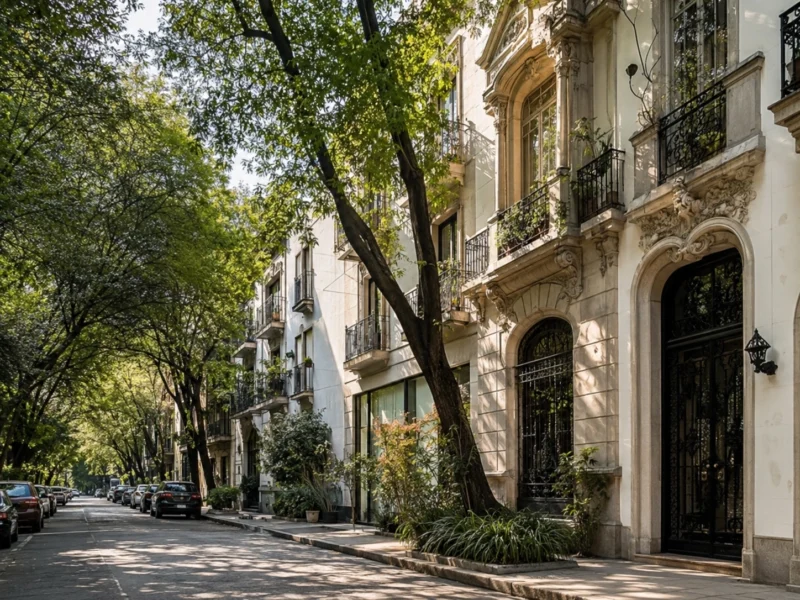
These spaces often resist the polished neutrality that has come to define global luxury. Their character depends on texture, color, and an acceptance of age. Timber is allowed to darken. Stone carries visible grain. Hand-finished surfaces retain small variations, and contemporary objects sit comfortably within rooms that reveal traces of several lives.
That layered quality is not a stylistic device. It is central to the way Mexico City has evolved.
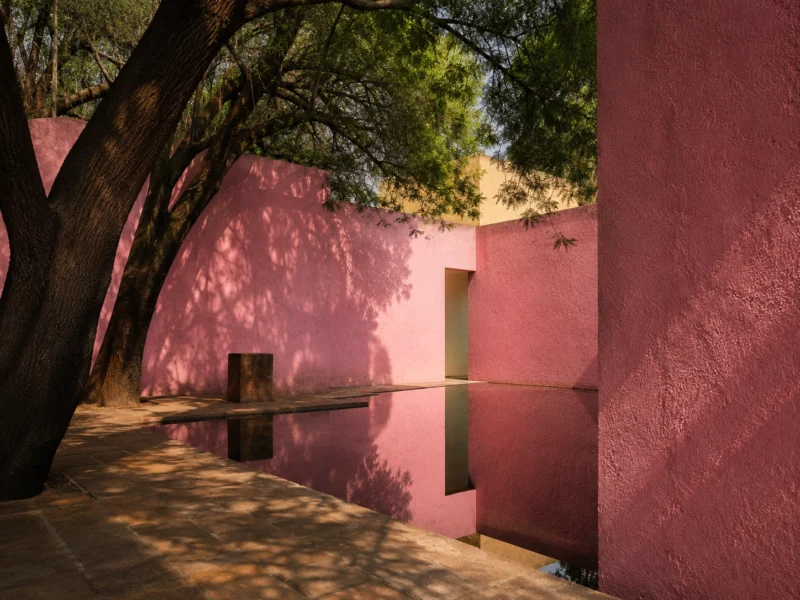
Barragán understood the emotional potential of such contrasts better than almost anyone. His own house and studio in Tacubaya presents a restrained exterior to the street, then unfolds into a sequence of rooms shaped by thick walls, filtered daylight, painted planes, timber beams, and carefully framed views of the garden. The architecture is rigorous, but it never feels clinical.
Its silence is part of the design.
Rooms are not presented all at once. A staircase rises without a conventional handrail. A wall blocks the view, then releases it. Light moves across rough plaster, changing the apparent intensity of the color throughout the day. Barragán’s work demonstrates that modernism need not be transparent or stripped of mystery. It can be private, spiritual, and deeply sensorial.
South of the center, Museo Anahuacalli offers a darker and more monumental expression of Mexican identity. Conceived by Diego Rivera to house his collection of pre-Hispanic objects, the building rises from volcanic terrain like an ancient structure reassembled through a modern imagination.
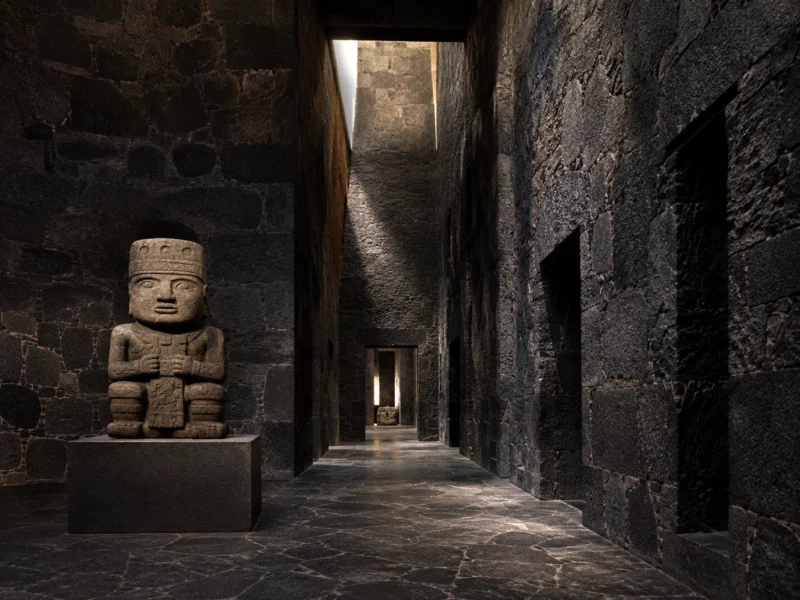
Its black stone walls, compressed passages, and geometric openings create an atmosphere that feels both ceremonial and severe. Light enters selectively, illuminating sculpture before falling away into shadow. The experience is less like walking through a conventional museum than moving through a constructed landscape of stone.
The surrounding lava fields are essential to the architecture. The building does not appear placed upon the site so much as drawn from it, its mass and material reinforcing the sense that the structure belongs to a much longer history. Anahuacalli continues to operate as a museum and cultural space, with exhibitions and workshops extending Rivera’s original vision beyond the collection itself.
Yet Mexico City’s design culture is not defined solely by its canonical houses and institutions. Its vitality is equally visible in the workshops and studios where designers are reconsidering local materials and techniques.
Contemporary furniture may combine volcanic stone with pale timber, or polished metal with woven natural fibers. Ceramics draw from regional traditions without reproducing them literally. Lighting designers use hand-hammered brass, blown glass, and translucent stone to create pieces that feel rooted in craft while remaining unmistakably current.
The most compelling work avoids reducing Mexican identity to bright color or familiar motifs. Instead, it engages with process: the way an object is made, the origin of a material, and the knowledge carried by the hand that shapes it.
This approach has given the city’s interiors a particular confidence. A sculptural chair may sit against an unfinished wall. A rough stone table may anchor an otherwise tailored room. Contemporary art, inherited furniture, market finds, and custom pieces are mixed without excessive concern for purity.
The result is rarely minimal in the conventional sense, even when the architecture itself is restrained. There is usually an element of interruption—an intense color, a surprising object, a garden entering the room, or a shaft of light that changes the balance of the composition.
Mexico City also understands the drama of the courtyard. Hidden behind street façades, these private spaces provide light, air, planting, and a moment of removal from the city’s intensity. Some retain colonial proportions; others are contemporary voids cut into new architecture. In both cases, they operate as rooms open to the sky.
Here, domestic life often turns inward. Windows frame greenery rather than the street. Water softens noise. Stone floors move seamlessly between interior and exterior, while walls create privacy without sacrificing atmosphere.
This inwardness gives the city’s most memorable spaces their sense of discovery. They are rarely understood from the façade. One must enter, turn, pause, and allow the architecture to unfold.
That may be the defining pleasure of Mexico City as a design destination. It does not offer a single visual language to be consumed quickly. It asks the visitor to recognize connections across time: between a pre-Hispanic object and a modernist volume, between ancient stone and contemporary furniture, between the formal geometry of a wall and the unruly growth of a garden.
The city is not designed in one layer, but many. Its beauty comes from the fact that none has entirely erased the one beneath it.
