

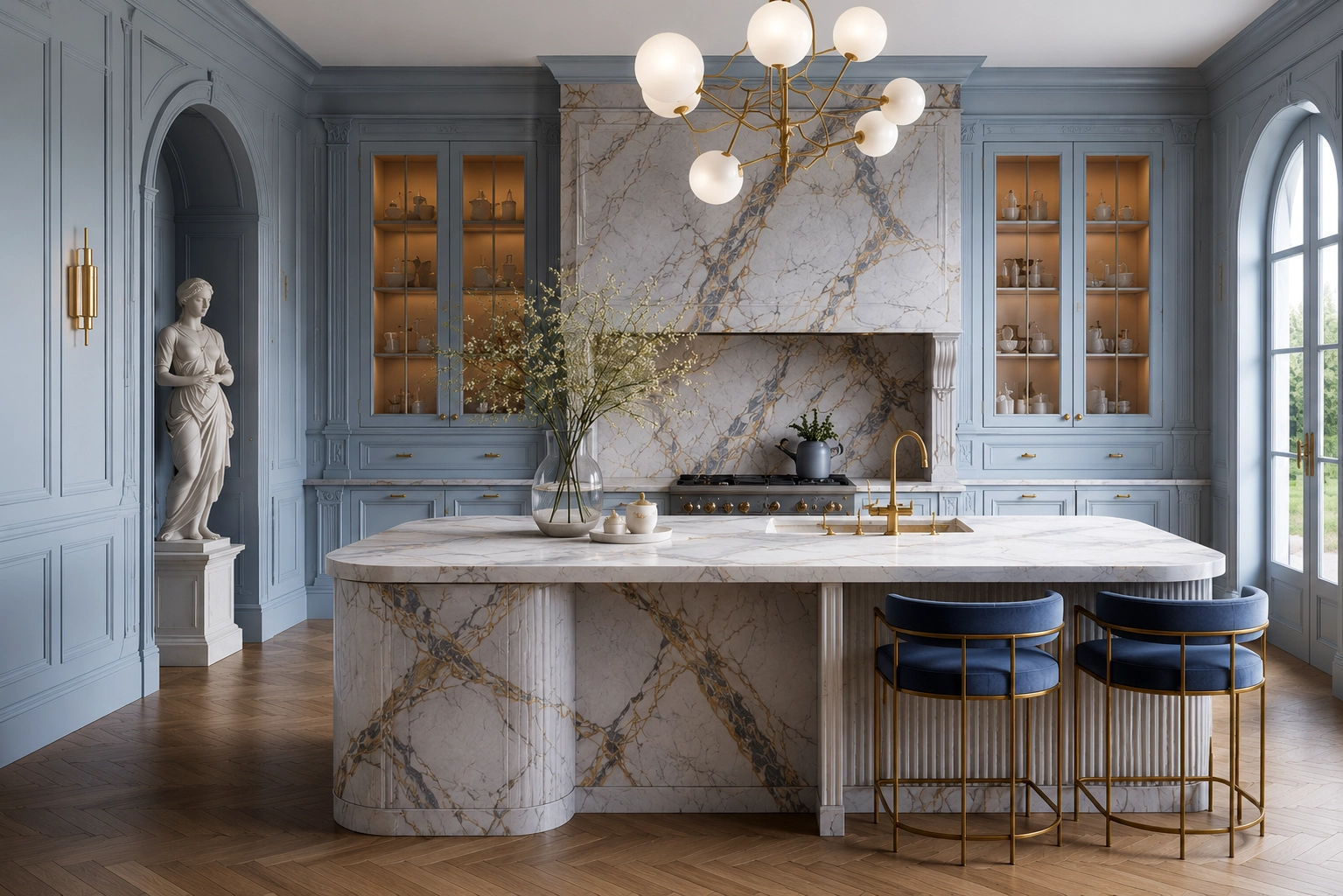
For years, the luxury kitchen was expected to whisper. Pale oak, quiet stone, handleless cabinetry, and restrained shades of ivory established a visual language of discretion. Beautifully resolved and endlessly adaptable, these interiors offered serenity—but they also created a certain predictability.
Now, color is returning to the kitchen with greater confidence, and few combinations feel as unexpectedly fresh as powder blue cabinetry set against expressive marble and French classical detailing.
The appeal lies in contrast. Blue carries an inherent softness, particularly when it appears in an airy, greyed or mineral-inflected shade. Marble introduces movement and visual drama. Classical references, symmetry, framed cabinetry, decorative molding, sculptural hardware, and carefully proportioned elevations bring order and permanence. Together, they create a kitchen that feels romantic without becoming nostalgic and contemporary without abandoning ornament.
This is not the familiar blue-and-white kitchen of coastal decorating. Nor is it a literal reproduction of a French country interior. The new interpretation is more architectural, more polished, and considerably more daring.
Cabinetry provides the foundation. Pale blue façades can give substantial millwork a sense of visual lightness, allowing tall storage walls and generous islands to feel less imposing. The color responds particularly well to natural daylight, shifting from silvery and cool in the morning to warmer and more atmospheric as evening approaches.
The precise shade is critical. A blue containing too much pigment can dominate the room, while one that is excessively grey may lose its vitality. The most sophisticated tones sit somewhere between sky, smoke, and faded cornflower. They retain enough color to establish identity while remaining quiet enough to support stone, metal, art, and architectural detailing.
Finish alters the effect further. A soft matte surface feels contemporary and understated. Satin paint reflects light gently and brings greater definition to paneled doors. A hand-painted finish, with its nearly imperceptible variations, can lend the cabinetry the character of traditional joinery without making the room feel historically themed.
Against this controlled field of blue, marble becomes the expressive element.
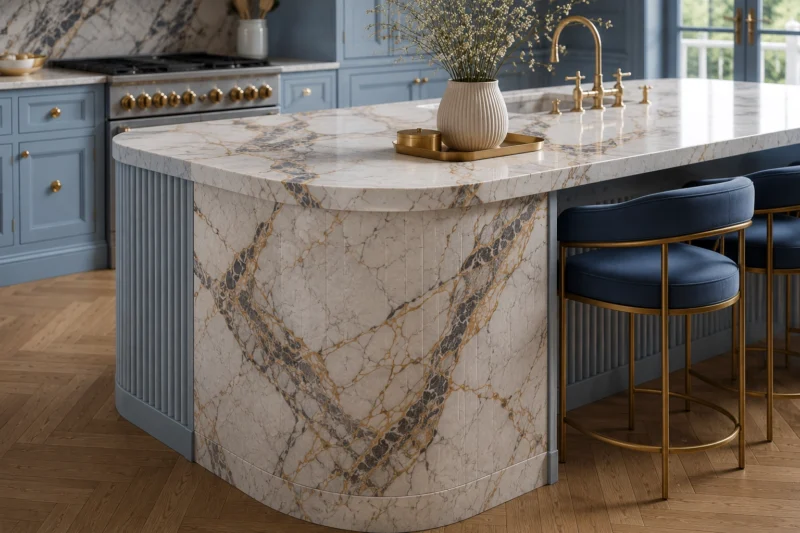
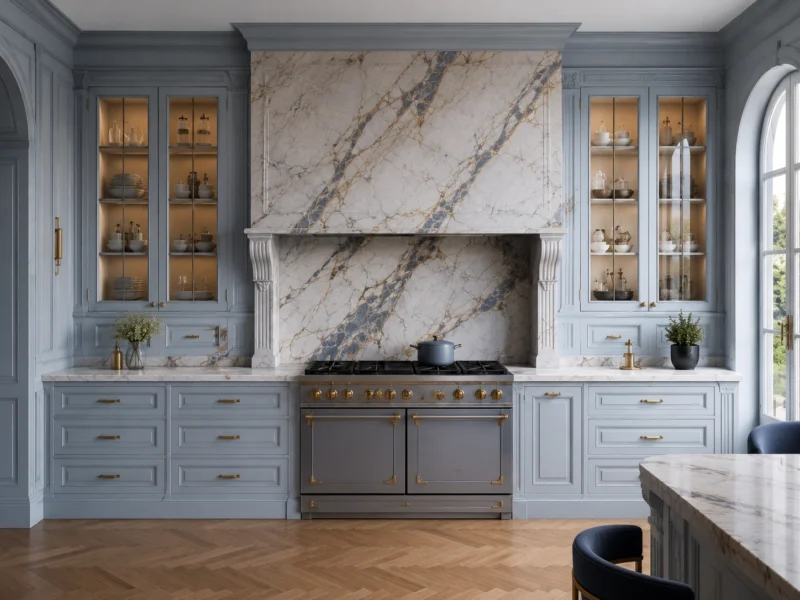
Rather than relying on discreet veining, the strongest kitchens embrace stone with visible movement: sweeping grey lines, ink-like fragments, rust-colored traces, or dramatic mineral deposits that cross the surface like abstract drawing. Used across an island, backsplash, or sculptural hood, the marble becomes more than a finish. It acts as the room’s principal artwork.
A monolithic island is especially effective. Its scale allows the stone pattern to unfold without interruption, while rounded corners or softly carved ends can temper the hardness of the material. When conceived as a sculptural volume rather than a conventional bank of cabinetry, the island gives the kitchen the presence of a gallery object.
Yet expressive marble requires restraint elsewhere. Veining should be carefully aligned, particularly where slabs meet across waterfall edges, backsplashes, and integrated sinks. Decorative accessories should remain limited, allowing the stone to retain its visual authority. Too many competing patterns can quickly turn richness into noise.
French classical influence enters through proportion rather than pastiche. Tall cabinet doors, balanced elevations, discreet cornices, fluted details, and framed panels suggest a tradition of fine joinery without reproducing a period kitchen. The objective is not historical accuracy but architectural composure.
A contemporary kitchen can accommodate a paneled façade or decorative molding when those elements are simplified and precisely scaled. The same is true of hardware. Polished nickel, aged brass, or dark bronze can bring definition to blue cabinetry, but ornate handles and elaborate backplates should be used selectively. The most convincing rooms allow one or two traditional gestures to carry the classical narrative.
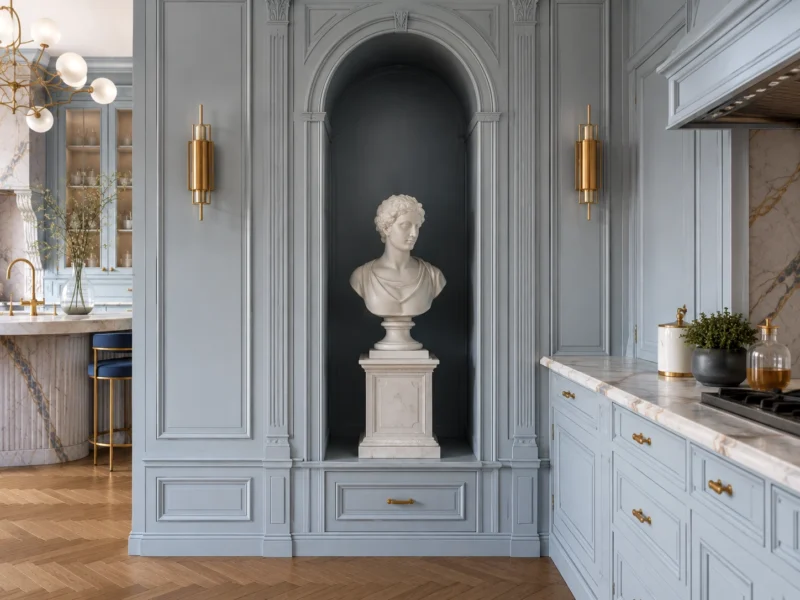
The inclusion of sculpture adds another layer. A classical bust or historic figure placed within a niche, on a pedestal, or against a paneled wall creates a charged dialogue between old and new. Beside crisp cabinetry and a highly contemporary island, the object appears less like decoration and more like a cultural presence.
This juxtaposition works because sculpture introduces the human form into a room governed by planes and volumes. It lends gravity to the composition while heightening the modernity of the surrounding design. A fragment of antiquity can make sharply resolved cabinetry feel even more current.
Lighting should support this dialogue rather than compete with it. Concealed illumination beneath shelving can reveal the depth of the blue finish, while narrow beams directed across marble emphasize its relief and veining. A sculptural pendant may work above the island, although the fixture should not obscure the stone or interrupt important sightlines.
Natural light remains the ideal companion. Blue cabinetry benefits from generous windows, reflective surfaces, and a sense of air around the millwork. In a darker room, the same palette may require warmer artificial light, pale flooring, and carefully placed mirrors to prevent the color from feeling heavy.
The surrounding materials should be selected with similar discipline. Light oak introduces warmth and prevents blue and marble from becoming too formal. Plaster walls offer softness. Brushed metal contributes a restrained gleam, while upholstered counter stools in cream, parchment, or muted tobacco provide tactile contrast.
What makes the combination so compelling is its ability to resist a single classification. It is classical but not conventional, colorful but not exuberant, luxurious but not dependent upon excess.
The blue marble kitchen signals a broader change in residential design: a willingness to reintroduce emotion, historical reference, and visual identity into the most functional room in the home. After years of anonymous neutrality, the kitchen is once again becoming a place for composition, character, and surprise.
Here, cabinetry does more than store. Marble does more than perform. Sculpture does more than decorate. Together, they create an interior in which the kitchen becomes an art object—and everyday rituals unfold within the frame.
