

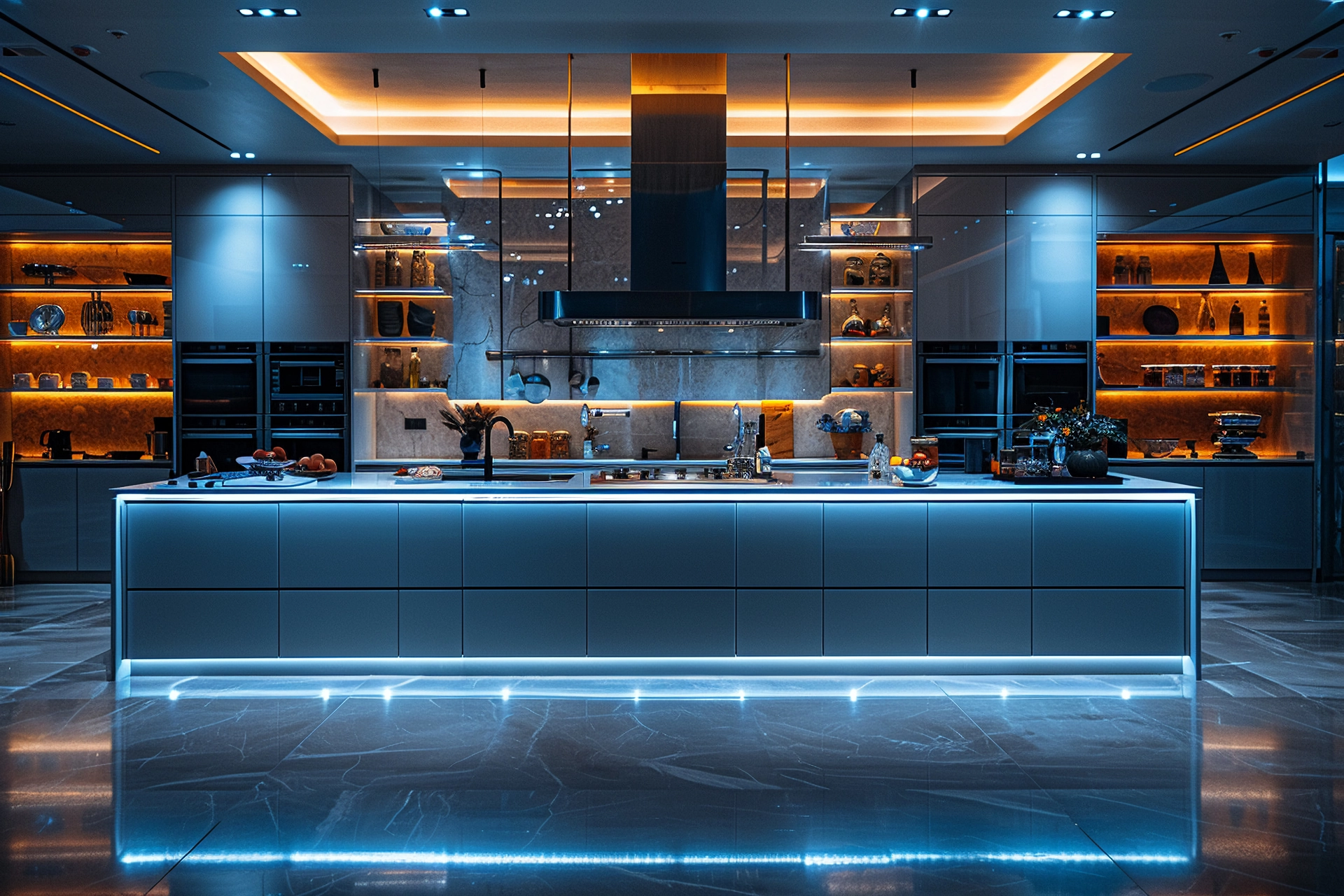
LED strip lighting is one of the most discreet tools available to an interior designer. Concealed beneath cabinetry, recessed into shelving, tucked behind a headboard, or integrated into a ceiling cove, it can give a room depth and atmosphere without introducing another visible fixture.
Used without restraint, however, the same lighting can make even an expensive interior feel unfinished. Exposed diodes, inconsistent color, harsh brightness, visible wiring, and poorly planned transitions quickly reveal the difference between architectural lighting and an improvised installation.
The most successful schemes begin not with the strip itself, but with a clear understanding of what the light is meant to accomplish.
Before comparing lengths, colors, or controls, decide whether the lighting will serve a functional or decorative purpose. LED strips beneath kitchen cabinets may provide useful task lighting, while illumination inside a bookcase is primarily atmospheric. A concealed line along a staircase can improve visibility, whereas a ceiling cove is designed to cast soft, indirect light across the room.
Each application requires a different level of brightness, positioning, protection, and control. Attempting to use the same product everywhere often produces inconsistent results.
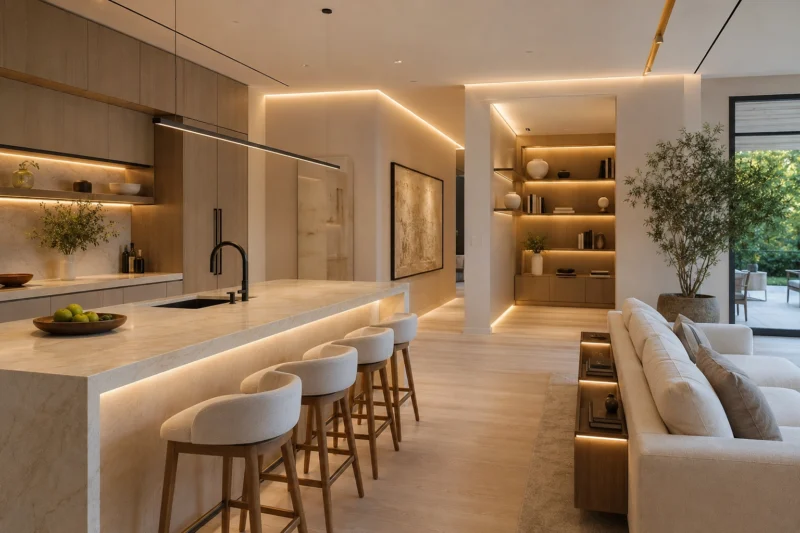
The strip should also remain concealed whenever possible. In a refined installation, the viewer sees the effect of the light rather than the individual source. Recessed channels, architectural reveals, and carefully positioned millwork allow the illumination to wash across a surface without exposing the strip itself.
Length matters, but it is only the beginning of the specification. LED density, the number of individual diodes positioned along the strip, has a significant influence on how continuous the light appears.
When the diodes are spaced too far apart, they can create a dotted or scalloped effect, particularly on glossy stone, glass, lacquered cabinetry, or other reflective surfaces. Higher-density products generally create a smoother line of light, especially when paired with a diffuser.
Longer runs also require careful electrical planning. As the distance increases, the light can lose intensity toward the end of the strip if the voltage, wiring, driver, and power feed have not been correctly calculated. Complex or permanently integrated installations are best reviewed by a qualified electrician or lighting professional before cabinetry and wall finishes are completed.
Applying adhesive LED tape directly to a finished surface may be adequate for a temporary installation, but it rarely creates the most polished result.
An aluminum channel provides a straighter mounting surface and helps create a purpose-built architectural detail. A frosted or opal diffuser placed over the strip softens the illumination and reduces the appearance of individual light points.
The depth of the channel matters. When the diffuser sits too close to widely spaced diodes, the individual points may remain visible. A deeper profile or denser strip gives the light more space to blend before it reaches the cover.
The channel should be selected as part of the millwork or architectural design rather than treated as an accessory at the end of the project. It can be recessed beneath shelving, concealed within cabinetry, or aligned with plaster and ceiling details for a cleaner finish.
Watts describe energy consumption, not the amount of visible light produced. Brightness should be compared in lumens, ideally expressed per foot or per meter so that products can be evaluated consistently.
A strip intended to illuminate a kitchen counter will generally require more output than one used behind a television or beneath a floating vanity. More brightness is not always better. An excessively bright strip can flatten the room, create glare, and draw attention away from architectural materials.
Dimming is therefore essential in many residential applications. It allows task lighting to perform at full output when needed and then recede into a softer evening setting. The strip, driver, and dimmer must be compatible; mismatched components can lead to flickering, buzzing, limited dimming range, or uneven performance.
Color temperature describes whether white light appears warm, neutral, or cool and is measured in kelvins.
For most living rooms, bedrooms, dining rooms, and hospitality-inspired interiors, 2700K to 3000K creates a warmer, more intimate atmosphere. Kitchens, bathrooms, dressing rooms, and workspaces may benefit from a slightly clearer 3000K to 3500K, depending on the surrounding materials and other light sources.
Very cool white light can feel clinical in a residential setting, particularly when used against warm woods, natural stone, bronze, or richly colored textiles. Consistency is equally important. LED strips installed beside recessed lights, pendants, or wall sconces should share a compatible color temperature unless the contrast is intentional.
Tunable-white systems allow the color temperature to shift throughout the day, while warm-dim products become warmer as the light level is reduced, echoing the behavior of incandescent and halogen lighting.
Color temperature determines how warm or cool the light appears. Color rendering describes how faithfully that light reveals finishes, furnishings, artwork, food, and skin tones.
The Color Rendering Index, or CRI, remains one of the most familiar specifications. A CRI of 80 is generally considered the minimum for interiors, while 90 or above offers greater color fidelity.
For a design-led residence, high color rendering is worth prioritizing. Beautiful stone can appear dull, timber can lose its warmth, and textiles can look strangely muted beneath poor-quality light. This is especially important in kitchens, dressing rooms, art displays, and spaces where material nuance is central to the design.
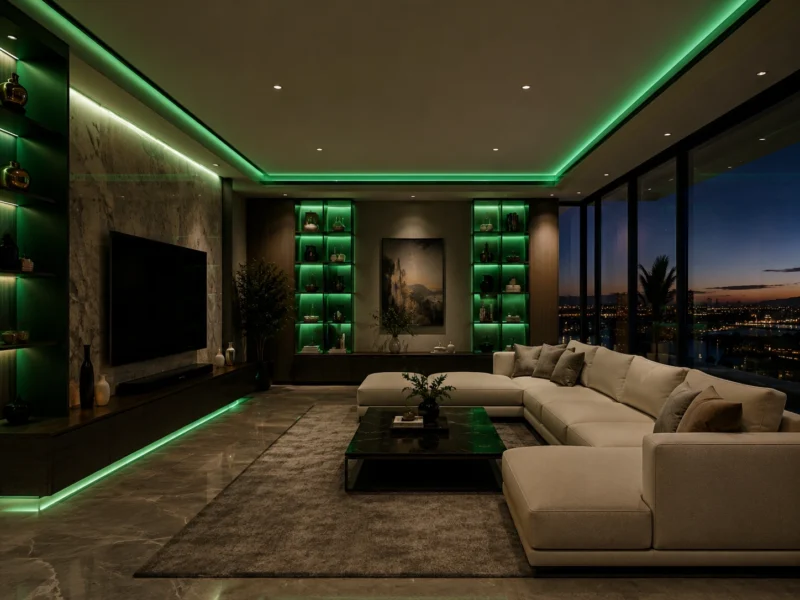
RGB and RGBW strips can introduce colored light, but they should be used with restraint. They are most effective in media rooms, children’s spaces, entertainment areas, or temporary decorative scenes.
For the principal rooms of a sophisticated home, high-quality white light is usually more enduring. Tunable white often provides greater everyday value than a broad palette of saturated colors.
When color-changing light is used, RGBW is generally more versatile than basic RGB because it incorporates a dedicated white-light component rather than attempting to create white by blending red, green, and blue.
Not every LED strip is suitable for every location. Dry interior shelving has different requirements from a bathroom vanity, covered terrace, landscape feature, or exterior step.
Products should be specifically rated for the conditions in which they will operate. Damp- and wet-location suitability are distinct classifications, and the driver, connectors, channels, and other components must be considered alongside the strip itself.
A coated strip alone does not guarantee that the entire installation is protected. Connections and power supplies must also be appropriately located and specified.
LEDs may last for years, but drivers, control modules, and connections can still require servicing. These components should remain accessible rather than being permanently sealed behind millwork or plaster.
The design should also anticipate replacement. A standard channel, removable diffuser, and accessible driver make future repairs far less disruptive. Permanently bonding an inexpensive strip into custom cabinetry may save money initially, but it can create unnecessary expense when the system eventually needs attention.
Ultimately, LED strip lighting succeeds when it is treated as part of the architecture. The best installations are measured, concealed, dimmable, and precisely matched to the materials and mood of the room.
The objective is not to see the technology. It is to notice how beautifully the space has been lit.
