

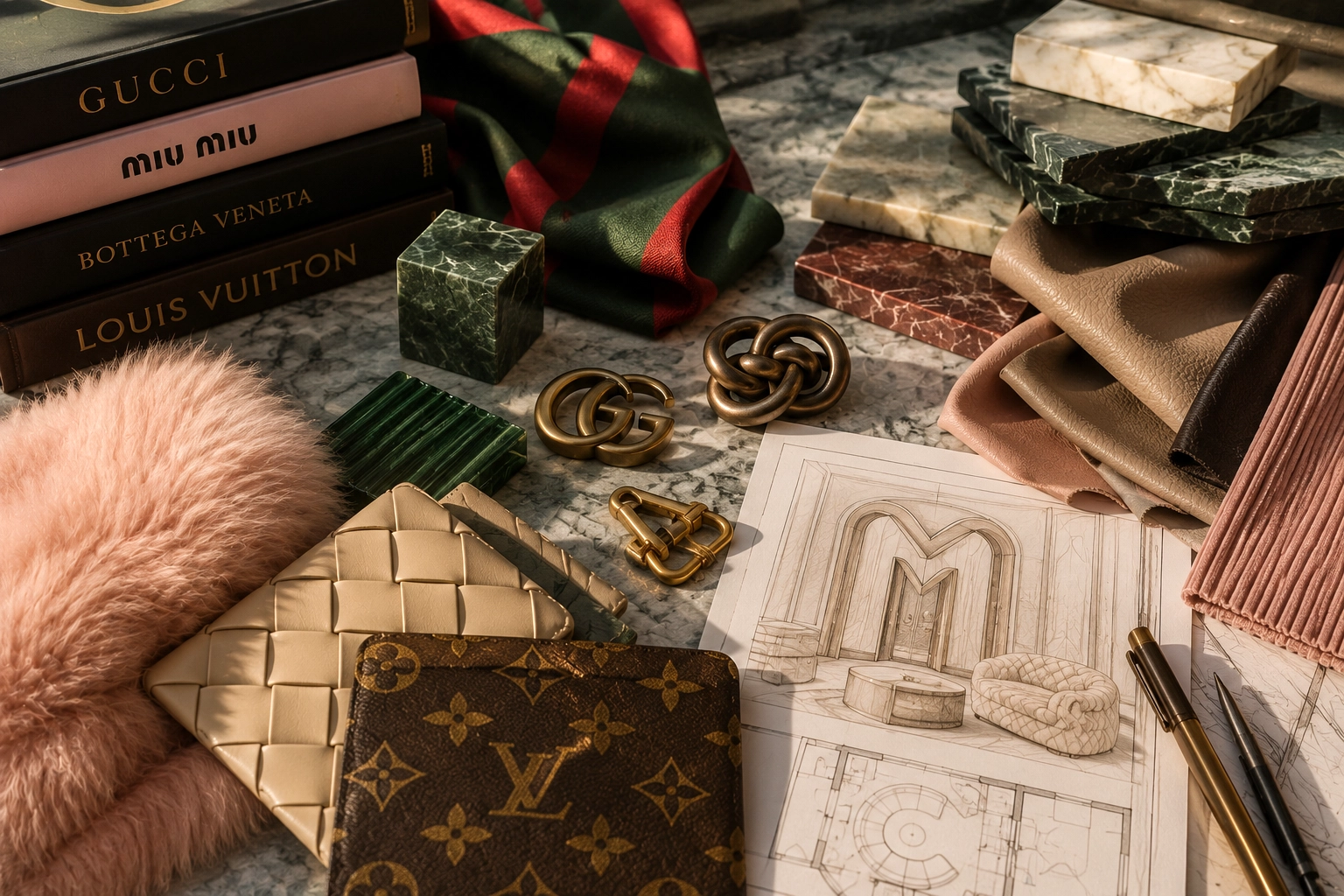
That question sits at the heart of a striking conceptual series by designer and 3D artist Sarah Habib, who imagines some of fashion’s most recognizable houses translated into interior space. Rather than treating branding as surface decoration, Habib turns identity into architecture, asking what might happen if the visual language of Miu Miu, Gucci, Bottega Veneta and Louis Vuitton were allowed to become walls, seating, thresholds and furniture.
The result is less about recreating a boutique and more about exploring how deeply a fashion house’s DNA can extend beyond clothing. Color, form, repetition, texture and symbolism become spatial tools. Logos stop behaving like logos. They begin functioning as geometry.
That distinction is what makes the series compelling.
Luxury fashion has spent years moving beyond the wardrobe. Houses now create furniture, restaurants, hotels, exhibitions and immersive environments designed to make a brand feel like a world rather than a product. Habib’s work pushes that idea into speculative territory, imagining interiors in which the character of each house is not merely referenced, but built into the architecture itself.
Her Miu Miu concept is perhaps the most playful.
Rather than relying solely on familiar fashion cues, Habib develops what she describes as a feline language of her own. An M-shaped entrance establishes the first clue, while fur-covered seating, a cat-inspired coffee table and a feline portrait amplify the idea. The concept plays on the soft, almost mischievous sound of the name itself, turning “Miu Miu” into a spatial personality.
There is a deliberate sense of whimsy to the room. Soft textures temper the more graphic architectural elements, while the feline references introduce an eccentricity that feels surprisingly aligned with the brand’s youthful, slightly subversive character. It is not an official Miu Miu interior, nor is it trying to be. Instead, it is an interpretation of mood, one that asks what the brand might feel like if its personality were given walls.
Gucci, by contrast, becomes more structural.
Habib’s concept begins with the letter G and allows it to take control of the space. A G-shaped sofa anchors the room, while a sculptural G entrance turns the brand’s identity into a threshold. Gucci’s familiar green-and-red palette appears around the fireplace, but the most interesting move is the refusal to use these elements as simple ornament.
Here, the brand becomes architecture.
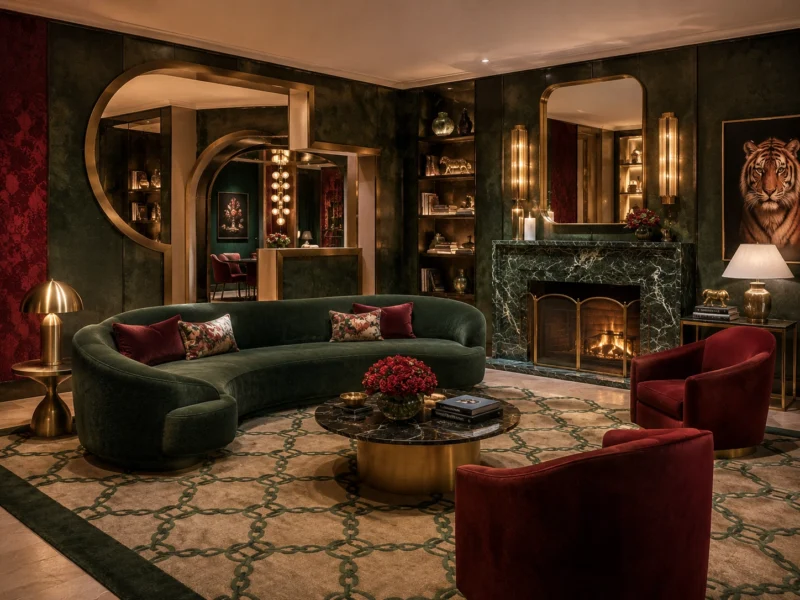
That is a subtle but important shift. Fashion-inspired interiors often fall into the trap of applying logos, monograms or signature colors to otherwise conventional rooms. Habib instead treats recognition as form. The Gucci identity influences circulation, proportion and furniture shape, allowing the space to operate more like a three-dimensional brand study than a decorated living room.
The effect is bolder than the Miu Miu concept and more theatrical, but it also demonstrates how immediately legible certain fashion codes have become. A color combination, a curve, a letterform or a material can be enough to evoke an entire house before a product appears.
Bottega Veneta offers a different challenge because its most recognizable language has long been rooted in craft rather than overt branding.
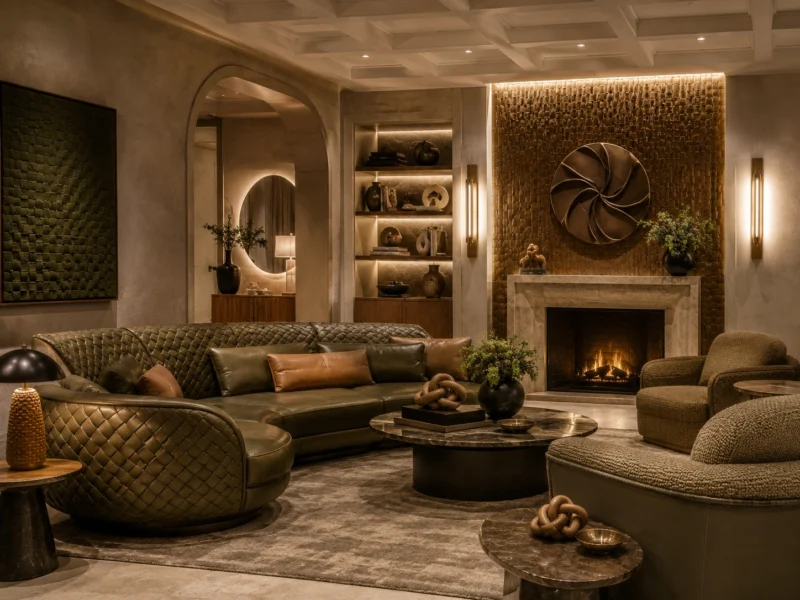
Habib responds by translating the house’s celebrated intrecciato weave into the surfaces of the room. What begins in leather becomes architecture, appearing across walls and furnishings in enlarged, tactile form. Sculptural knot details reference familiar accessories and hardware, while a restrained brass B quietly introduces the brand’s initial without disrupting the material story.
This is arguably the most sophisticated of the concepts because the transformation feels natural rather than imposed. Bottega Veneta’s identity has always been closely tied to construction, texture and the intelligence of materials, making the move from woven leather to interior surfaces particularly convincing.
The room suggests a larger idea about luxury design: the most powerful brand codes are often those that can survive a change of scale.
A weave designed for a handbag can become wall cladding. A knot can become sculpture. A detail originally intended to be held in the hand can expand until it defines the atmosphere of an entire room. When that translation works, the result no longer feels like fashion applied to interiors. It feels like a genuine exchange between disciplines.
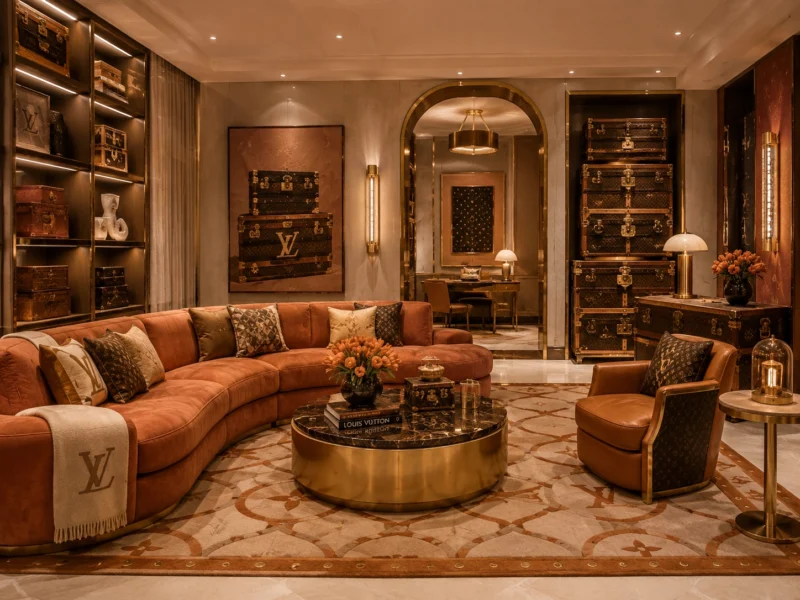
Louis Vuitton provides Habib with an even broader visual vocabulary.
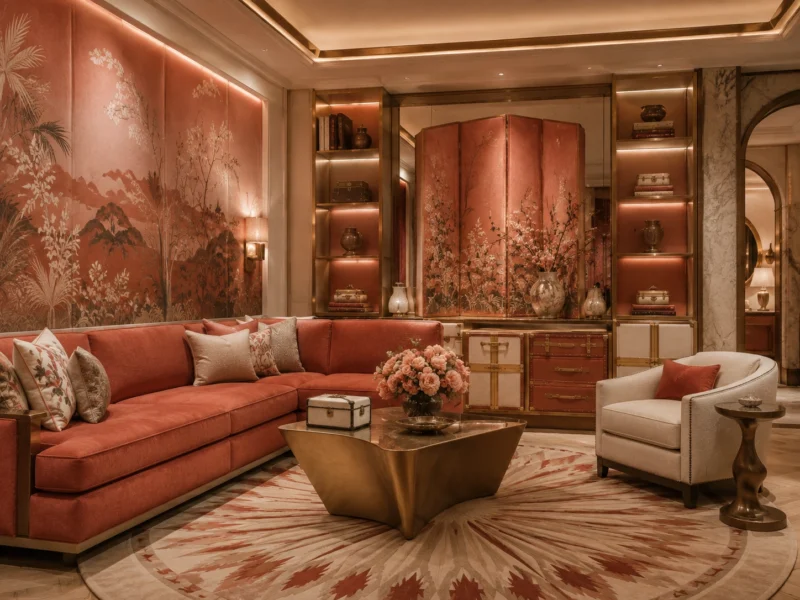
Rather than focus exclusively on the monogram, she turns toward the house’s more exuberant side, combining recognizable motifs with an L-shaped seating arrangement, a V-shaped table and floral forms carried across floors, walls and screens. The initials become geometry again, but this time within a more colorful, decorative environment.
The decision to move beyond the monogram is important. Louis Vuitton’s visual identity is so globally familiar that the obvious approach would have been to cover the space in repeated logos. Habib instead treats the brand as a source of proportion, pattern and rhythm, using its symbols as a starting point rather than a finishing layer.
That restraint keeps the concept from becoming caricature.
Across the series, what emerges most clearly is Habib’s interest in translation rather than imitation. These rooms do not claim to represent how the fashion houses themselves would design a residence, nor should they be mistaken for official collaborations. They are speculative interiors, imagined through the lens of a designer interested in how brand identity might behave when given volume.
That makes them particularly relevant to contemporary interior design.
The boundaries between fashion, furniture, hospitality and architecture have become increasingly porous. Luxury houses now routinely collaborate with designers and architects, while collectible furniture has taken on a cultural status once reserved for art and fashion. Increasingly, the question is not whether these worlds overlap, but how convincingly they can speak to one another.
Habib’s concepts suggest that the answer lies in understanding what makes a brand recognizable at its core.
For Miu Miu, that means wit, youth and eccentricity. For Gucci, identity becomes theatrical and graphic. Bottega Veneta translates through craft and material intelligence, while Louis Vuitton expands into pattern, color and movement.
None of the rooms relies on a single object to establish its identity. Instead, the brand codes are distributed throughout the space, allowing architecture, furniture and surface to work together.
That approach makes the series more compelling than a simple exercise in logo-driven fantasy.
At its best, fashion has always been about more than clothes. It creates atmosphere, aspiration and a way of seeing. Interiors do much the same, shaping how a person moves, gathers, rests and experiences space. When the two disciplines meet intelligently, the result can reveal how much of a brand’s power exists beyond the object itself.
Sarah Habib’s imagined rooms are not predictions of what these fashion houses will build next. They are something more useful: a study in how visual identity can migrate from the body to the built environment without losing its character.
The runway may be where the story begins, but increasingly, it is no longer where it ends.
