

“We’re the one with Roald Dahl outside.”
“Ours is the house with the Weeping Super Fairy standing guard.”
“Look for the Icebergs at the front gate.”
“We’re No. 12. But please forgive Ingrid Bergman for not looking her best. She needs a haircut.”
For rose lovers, Sat Nav can seem almost redundant. When the garden is populated by Princess Anne, Emily Brontë, Gabriel Oak and Winchester Cathedral, even an address begins to acquire a certain theatricality.
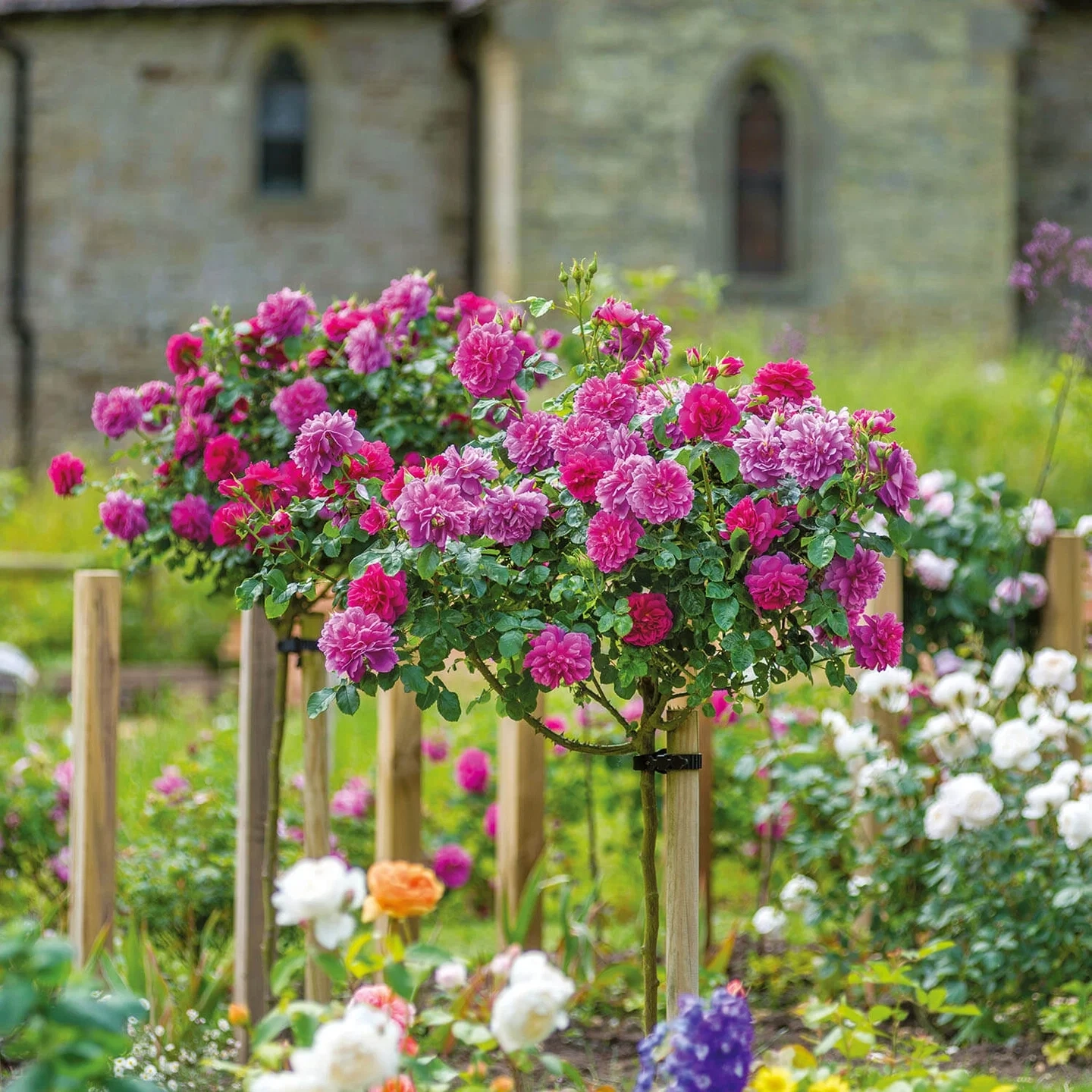
Standard roses have always had that effect. With their tall, architectural stems and rounded crowns of flowers, they bring height, ceremony and just enough eccentricity to a garden to make them irresistible. They are sometimes compared to lollipops or umbrellas, which is hardly the most flattering language for something capable of introducing such elegance to a terrace, courtyard or formal path. Yet their appeal lies precisely in that sculptural quality: they lift roses from the flower bed and place them at eye level, where color, fragrance and form can be appreciated without crouching among the borders.
More importantly, they give a landscape structure. A pair of standards can transform an entrance. A procession of them along a drive establishes rhythm and symmetry. Positioned within a mixed border, they create a vertical layer above lower planting. Around a terrace or seating area, they turn the garden into something that feels composed rather than merely planted.
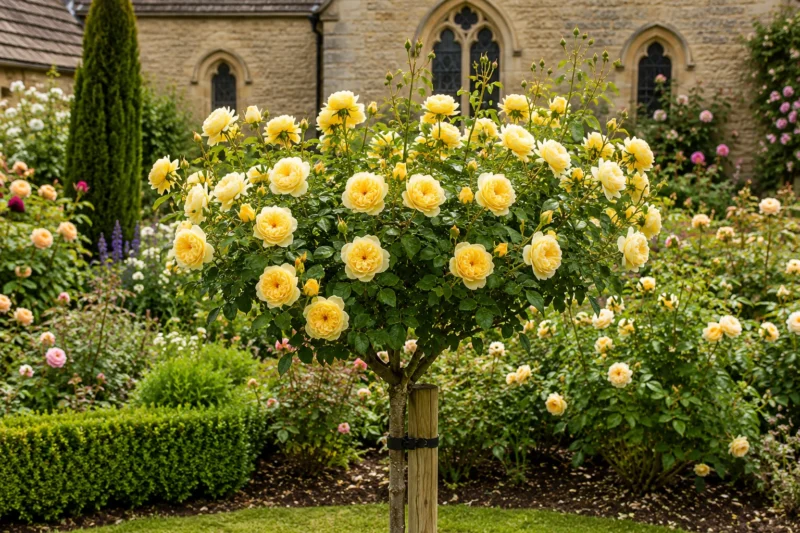
The standard rose is not a modern invention. Rose trees began appearing in Europe in the late 18th century, with German nurseries among those cultivating the root and stem stock required to create them. By the early 19th century, they had become fashionable in formal French gardens and, later, in Victorian England, where a well-dressed garden might place standards around fountains, along promenades or beside entrances. They were horticulture with a little social ambition attached.
That sense of grandeur remains, although the contemporary standard rose need not belong exclusively to an aristocratic garden. Today it can just as easily soften a modern terrace, frame the steps of a townhouse or introduce romance to an otherwise restrained landscape scheme.
Technically, there is little mysterious about them. A standard is essentially a rose cultivated on a tall stem, with the flowering variety grafted at the top. The difference is visual rather than botanical. What would normally bloom closer to the ground is elevated into a living canopy.
The result can range from the compact and controlled to the wonderfully dramatic. Half-standard roses typically flower at approximately 40 to 60 centimeters above the ground, while traditional standards rise to around 70 to 90 centimeters. At the more theatrical end of the spectrum are weeping standards, often reaching around 140 centimeters before their long, flexible stems spill downward in cascades of blossom.
It is this weeping form that comes closest to turning a rose into garden architecture. Mature crowns can spread roughly a meter or more across, and during the height of summer the effect can be spectacular. Flexible varieties such as ‘Guirlande d’Amour’ or ‘Super Dorothy’ form soft, trailing canopies, while varieties including ‘Raubritter,’ ‘Apfelblüte’ and ‘Jasmina’ create their own variations on the theme.
Claude Monet understood the power of this kind of planting. His celebrated garden at Giverny used roses not merely as flowers but as spatial devices, shaping views, framing walks and adding layers of color and movement. The famous rose-covered structures there demonstrate an idea that still resonates: a rose can be more than something admired from above. It can become part of the architecture of the garden itself.
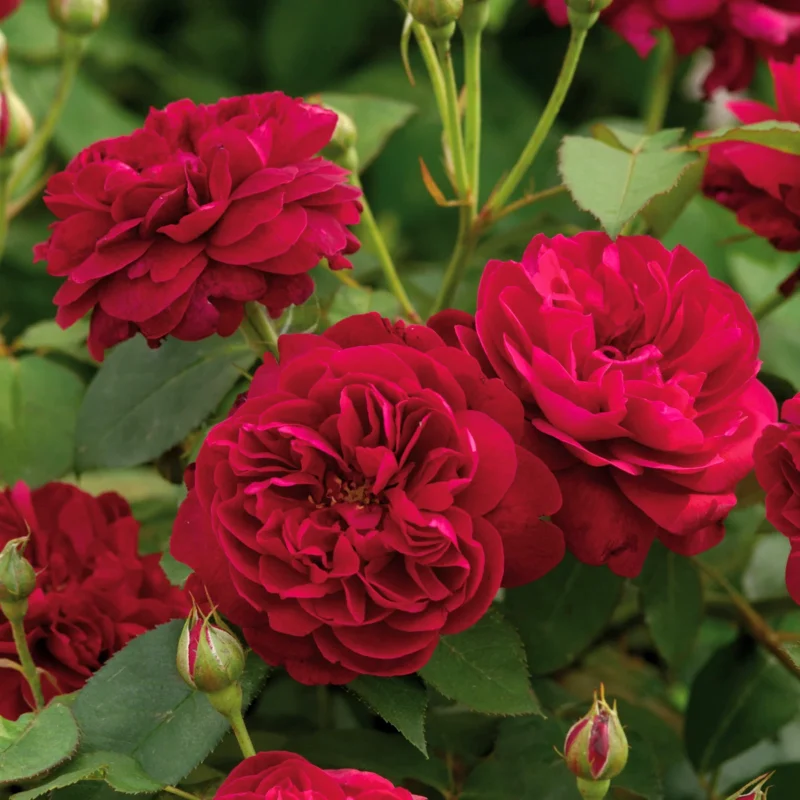
David Austin Roses has played an important role in sustaining that tradition, offering standards across a range of forms and characters. Names such as Tranquillity, Molineux, Eglantyne, Port Sunlight, Gabriel Oak, Lady of Shalott, Princess Anne, Olivia Rose Austin, Scepter’d Isle, Emily Brontë, Darcey Bussell, Winchester Cathedral and Young Lycidas read almost like a particularly well-connected guest list.
And that is part of their charm. Roses carry names, histories and personalities in a way few other plants do. A line of standards can therefore feel almost inhabited, as though the garden has assembled its own cast.
The best use of them, however, is not simply decorative. Standard roses can create order in landscapes where planting might otherwise feel loose or informal. Repeated at measured intervals along a path or driveway, they establish a classical rhythm. Planted in pairs, they can frame an entrance with the formality of columns. In contemporary settings, they provide a useful counterpoint to clean architecture, introducing softness without sacrificing structure.
Underplanting also changes the mood entirely. Lavender creates a romantic, Provençal effect; clipped boxwood adds formality; alyssum and other low-growing flowers soften the base. In a minimalist garden, gravel or restrained groundcover allows the rose itself to become the principal gesture.
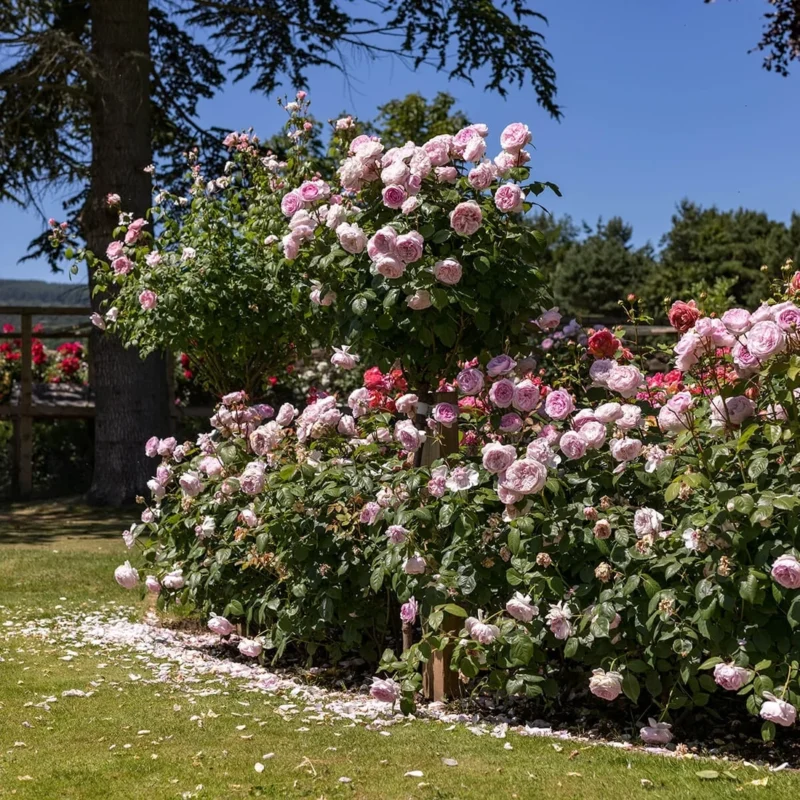
For all their grandeur, standards do require a little discipline. Because the flowering crown sits high above the ground, a sturdy support is essential, particularly in exposed locations. The stake should remain secure while the plant establishes itself, and ties should be checked periodically so they do not rub or constrict the stem.
Good soil preparation matters too. Bare-root standard roses are best planted during the traditional dormant season, generally from November through April, provided the ground is neither frozen, saturated nor excessively dry. David Austin Roses recommends hydrating a bare-root rose before planting, incorporating organic matter into the soil and watering thoroughly after planting.
Once established, the principles of care are familiar. Annual mulching helps conserve moisture and enrich the soil, while keeping the base free of weeds reduces competition. Roses should not be allowed to dry out completely, particularly during their first year, and colder climates may require protection around the crown.
Pruning depends on the type of rose. Repeat-flowering standards are usually pruned in early spring, with lighter attention following the first flowering. During the first few years, restraint is preferable: dead or weak stems are removed while the crown is allowed to establish. As the plant matures, older growth can be reduced more decisively to encourage younger, stronger stems and preserve the balance of the crown.
Weeping standards demand a slightly different hand. Their beauty comes from long, supple stems, so pruning should preserve movement rather than impose excessive formality. Once-flowering varieties are generally pruned after blooming, while repeat-flowering forms can be shaped more selectively. Training some stems horizontally can encourage greater flowering and help fill gaps in the canopy.
Yet none of this is what people remember when they encounter a beautiful standard rose.
They remember the composition.
They remember a pair of flowering crowns beside a front door, the procession of roses along a path, or the improbable elegance of a weeping rose throwing a curtain of blooms across a terrace. They remember that the garden suddenly seemed taller, more deliberate and perhaps a little more European.
That is the enduring appeal of the standard rose. It is not simply another way to grow a familiar flower. It transforms the rose into a piece of living sculpture.
And once your visitors have found the house and are seated on the terrace, looking out across the garden, who could resist saying:
“We are very fortunate. From here, we have wonderful views of Winchester Cathedral—and some rather impressive Icebergs.”
