

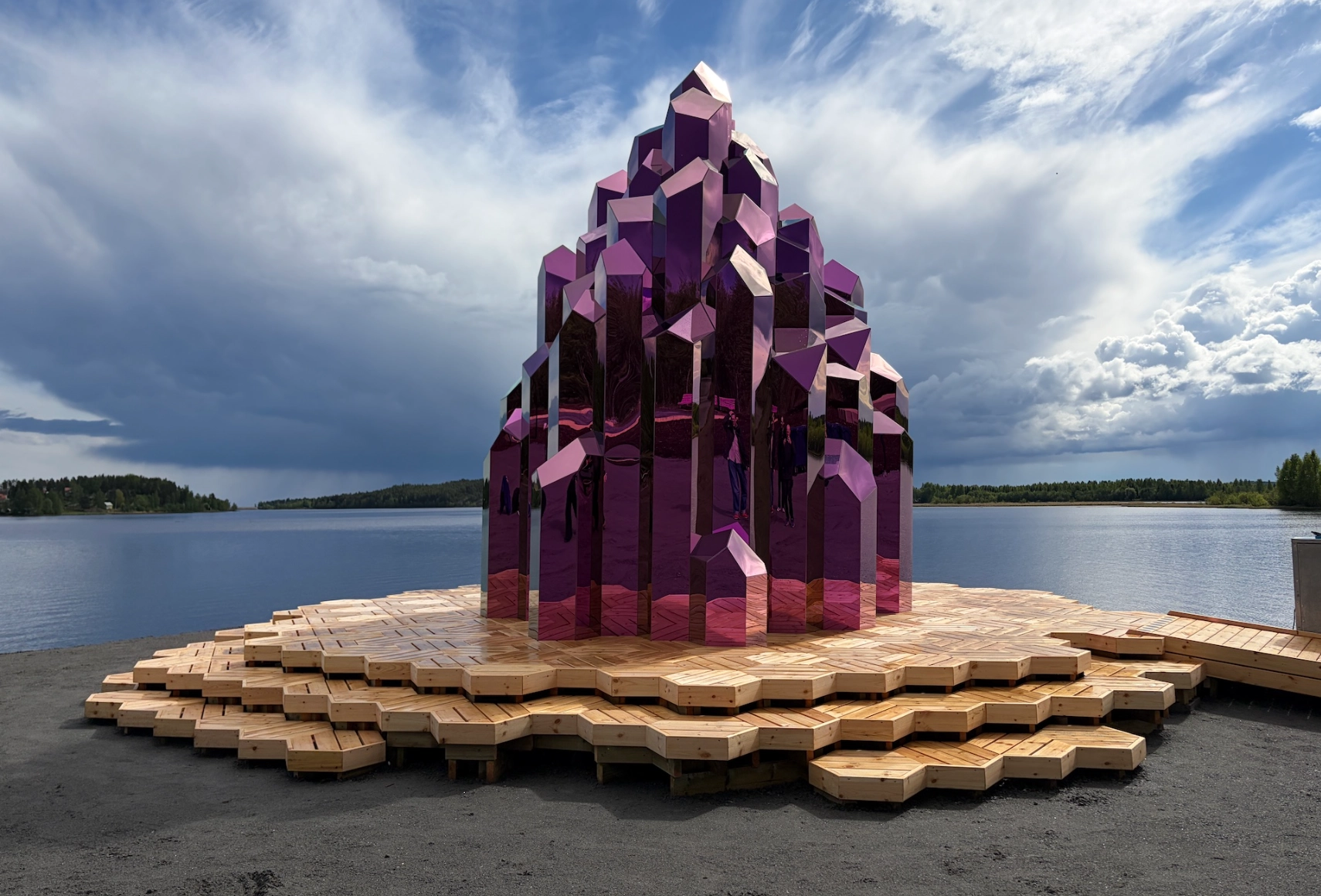
Along the bank of the Skellefte River in northern Sweden, a curious object now catches the landscape and throws it back in shades of blush pink, silver, and sky. From a distance, it could be mistaken for a fragment of some enormous mineral formation deposited beside the water. Move closer, however, and its purpose becomes wonderfully Scandinavian: this shimmering, faceted structure is a fully functioning public sauna.
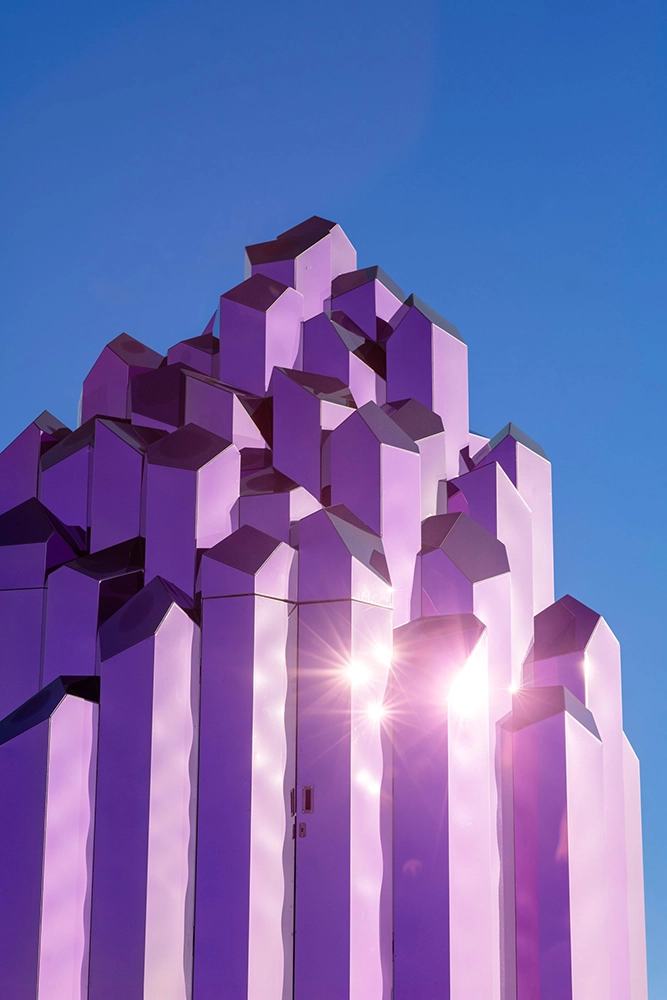
Created by Swedish artist duo Bigert & Bergström, the Lithium Crystal Sauna opened in 2026 at WasteLand – Climate Action Park in Skellefteå, where art, climate technology and public life have been brought together on a former industrial site. Shaped like a giant asymmetrical lithium crystal and wrapped in titanium-plated pink mirror steel, the sauna is both sculpture and social space, reflecting the river, surrounding vegetation and changing northern light across its irregular surfaces.
The choice of lithium is anything but arbitrary. Skellefteå has become closely associated with the industrial and technological transformation taking place across northern Sweden, particularly around electrification and battery development. Bigert & Bergström use the crystal form to turn that contemporary identity into something tangible, but the reference carries a second, more human dimension as well. Lithium is not only a material central to modern battery technology; it has also long been associated with psychiatric medicine, giving the sculpture a deliberately layered symbolism that moves between energy, vulnerability and the complicated promises of technological progress.
That duality is characteristic of Bigert & Bergström’s work. The duo has long explored the relationship between climate, technology and human behavior, often creating installations that are as visually seductive as they are conceptually uneasy. Here, the sauna becomes a particularly effective medium because few spaces are more closely woven into Nordic ideas of ritual, restoration and conversation. What could have remained an abstract meditation on energy transition instead becomes something people can enter, heat, inhabit and share.
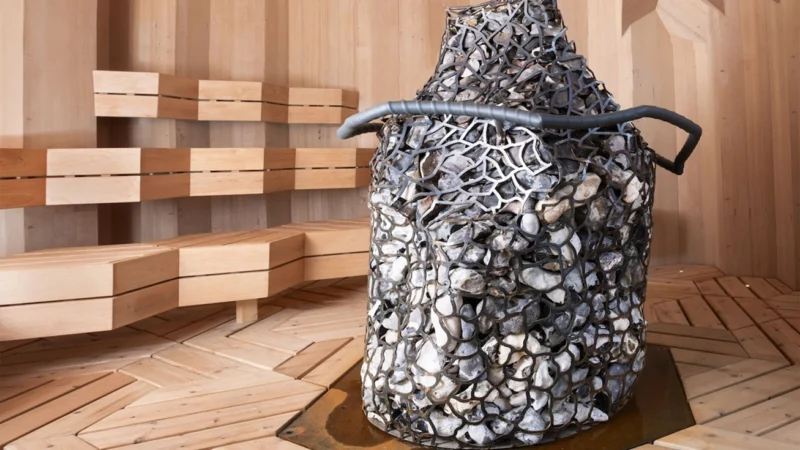
The exterior is deliberately futuristic, almost jewel-like in its precision, but stepping inside reveals an entirely different atmosphere. Pale timber replaces mirrored metal, and the crystal geometry continues through faceted walls and angular surfaces that soften under the warmth of wood. A geometric tiled floor and a stove surrounded by stone reinforce the sense that visitors have entered a contemporary grotto, somewhere between traditional sauna culture and an architectural experiment. The contrast is beautifully judged: industrial and reflective on the outside, tactile and restorative within.
The technology behind the heat is equally central to the story. Skellefteå Municipality describes the installation as being equipped with the world’s first battery-powered sauna heater, connecting one of Sweden’s oldest communal rituals with the technologies now reshaping energy use. In the context of WasteLand, that is more than a clever engineering flourish. It turns the sauna into a functioning demonstration of how energy storage can become part of ordinary social infrastructure rather than remaining an invisible technical system.
Yet the setting may be even more significant than the structure itself. WasteLand occupies land with a difficult industrial history. According to Skellefteå Municipality, the site underwent 17 years of soil remediation before reopening as a public park devoted to art, climate dialogue and ideas about future society. What was once contaminated ground has been recast as a place designed to invite people back in, not by erasing the past, but by making transformation itself the subject.
The Lithium Crystal Sauna stands at the center of that ambition. Around it, WasteLand brings together artworks, greenhouse structures, observation points and research-oriented interventions exploring relationships between nature, industry and people. Artists, universities, municipal organizations and energy companies have all contributed to the project, making the park less a conventional sculpture garden than a living laboratory for questions that rarely have simple answers.
There is something particularly compelling about placing a sauna at the heart of such a project. Climate transition is often discussed through figures, infrastructure and policy, all of which can feel remote from daily experience. A sauna makes the subject physical. Visitors feel the heat, sit beside one another, watch the landscape through the structure and experience energy not as an abstract quantity but as something producing warmth in real time.
That communal role has deep cultural resonance in Scandinavia, where sauna culture has traditionally been as much about gathering as cleansing. At WasteLand’s opening, the role of the sauna as a social meeting place was itself part of the conversation, with the Swedish Sauna Academy participating in discussions about why shared environments for relaxation and exchange can matter within sustainable communities.
The project also avoids the trap of presenting sustainability as visually austere. The Lithium Crystal Sauna is unapologetically beautiful. Its pink mirrored skin can appear almost liquid beside the river, dissolving portions of the structure into reflections of birch, water and cloud. The effect changes constantly with weather and season, ensuring that an object born from industrial references never quite separates itself from the natural environment surrounding it.
That beauty, however, is not intended to smooth over the contradictions embedded in lithium itself. The material has become emblematic of the shift toward electrification, yet its extraction and processing carry their own environmental and social questions. Bigert & Bergström’s crystal therefore works best when understood not as a monument celebrating technology, but as an object asking what progress actually looks like when viewed from several angles at once.
This is where the architecture becomes especially effective. A crystal has no single face, and neither does the transition the artwork represents. Lithium can signify cleaner mobility and environmental pressure, industrial growth and ecological concern, technological optimism and human fragility. The sauna holds these tensions without attempting to resolve them, inviting visitors instead to inhabit them for a while.
There is also a certain wit in the concept. Sweden could have marked its changing industrial identity with another visitor center, pavilion, or technology showcase. Instead, it built something people can sit inside while sweating beside strangers. That choice gives the project warmth in both the literal and cultural sense, grounding grand questions about climate and technology in one of the simplest pleasures imaginable.
Completed as part of Society Expo 2026, WasteLand was conceived as a demonstration of how places undergoing profound economic and environmental change might create new forms of public life. Society Expo itself brought together discussions around sustainable development and the future of communities, while WasteLand offered a physical expression of those ambitions on land already transformed once by industry and again by remediation.
For travelers accustomed to associating Nordic wellness with discreet timber cabins beside icy lakes, the Lithium Crystal Sauna presents something far more provocative. It retains the essential pleasures of heat, wood, stone and communal ritual, but wraps them in an object that looks as though it belongs to a speculative future. That tension between familiar experience and radical form is precisely what gives the project its allure.
Perhaps the most luxurious thing about it is not the mirrored metal or futuristic technology at all, but the intelligence of the experience. The sauna asks visitors to consider where energy comes from, what landscapes carry after industry leaves, and how public spaces might be designed not simply for recreation but for reflection. It manages to do so without sacrificing pleasure, which may be the most persuasive form of sustainable design.
On the Skellefte River, the result is a building that is sculpture, sauna, battery experiment, and conversation piece all at once. As the pink facets catch the birches and water around them, the Lithium Crystal Sauna becomes difficult to separate from the landscape it reflects, even while remaining unmistakably artificial within it. In that contradiction lies its greatest success: a vision of the future that does not ask people merely to observe change, but to step inside, sit down and feel the heat.
