

For decades, the ceiling was treated as the quietest surface in the room: painted white, punctuated by recessed lighting, and largely left to disappear. Designers devoted their attention to walls, furnishings, textiles, and art, while the space overhead remained visually passive. That hierarchy is changing. The ceiling, often described as the “fifth wall”, has become one of the most compelling opportunities in contemporary interiors, and antique chandeliers are leading its revival.
A chandelier does something few decorative elements can accomplish. It occupies the center of a room without taking up floor space, creates atmosphere before a single lamp is switched on, and gives the eye an immediate point of arrival. Suspended above an entry hall, dining table, staircase, or living area, it can establish the mood of an entire interior.
More than illumination, a chandelier creates a sense of occasion. It can make a foyer feel ceremonial, lend intimacy to a dining room, or bring a layer of grandeur to an otherwise restrained living space. Guests may eventually notice the upholstery, artwork, and accessories, but the object overhead often forms the first and most lasting impression.
This renewed interest in statement lighting reflects a broader change in the way homeowners approach luxury. The most memorable interiors are no longer defined by flawless coordination alone. Increasingly, they are shaped by pieces with character, history, and emotional presence. Antique chandeliers offer all three.
Unlike a newly manufactured fixture designed to blend discreetly into a scheme, an antique chandelier arrives with a distinct identity. Its patina, proportions, craftsmanship, and materials can introduce complexity to even the most minimal room. The contrast is often what makes it compelling: an ornate French crystal chandelier suspended above a sculptural contemporary table, a carved-wood fixture set against plaster walls, or a Murano glass composition illuminating a modern stair hall.
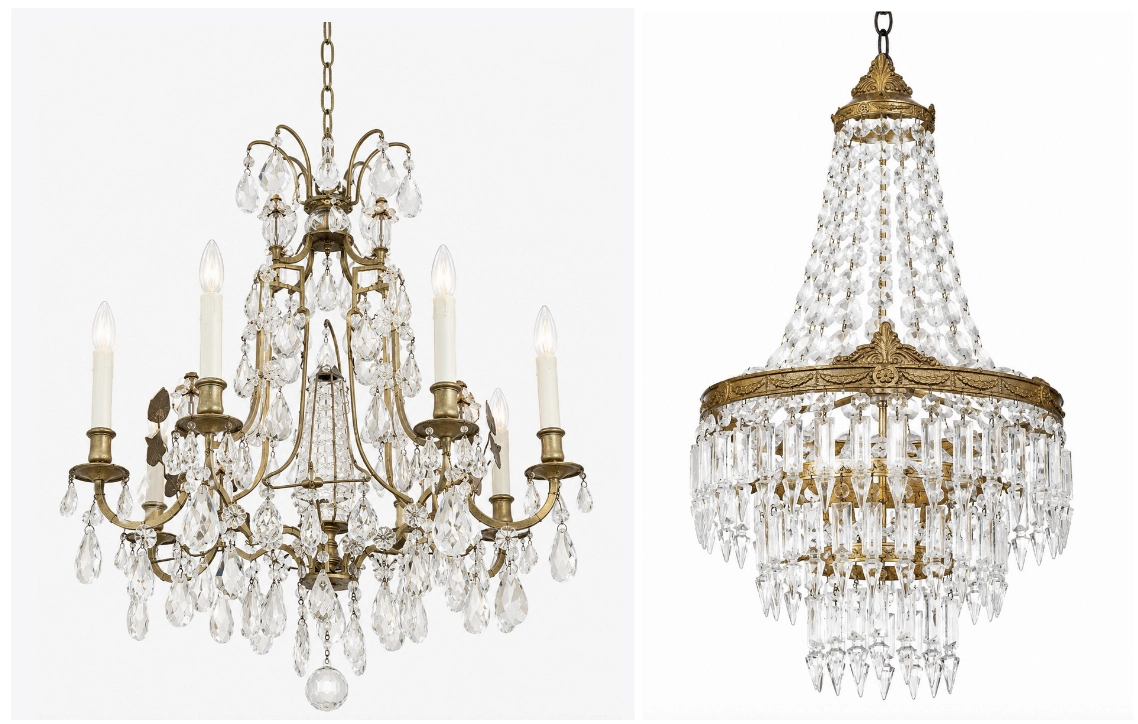
French crystal chandeliers remain among the most theatrical. Their faceted drops and branches catch and scatter light throughout the day, changing character as the sun moves across the room. In the evening, the effect becomes warmer and more atmospheric, with reflections animating nearby walls, mirrors, and polished surfaces. The appeal lies not simply in sparkle, but in movement. A crystal chandelier makes light visible.
A 1920s crown fixture creates a different experience. Often more architectural in form, it introduces symmetry, proportion, and a sense of ceremony without relying on elaborate ornament. These pieces can feel particularly effective in transitional interiors, where their period elegance adds depth without dictating the entire room.
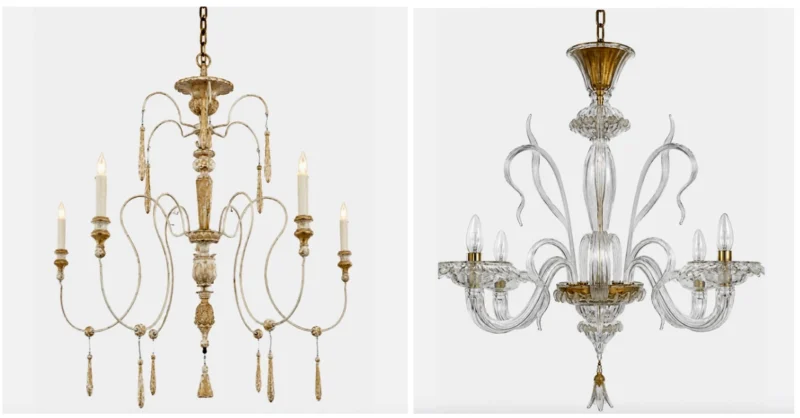
Carved-wood chandeliers bring warmth and sculptural presence. Their materiality makes them well suited to rooms with stone, plaster, linen, and natural timber, where they can soften the architecture and create a more relaxed sense of grandeur. Depending on their finish, they may read as rustic, Continental, ecclesiastical, or quietly modern.
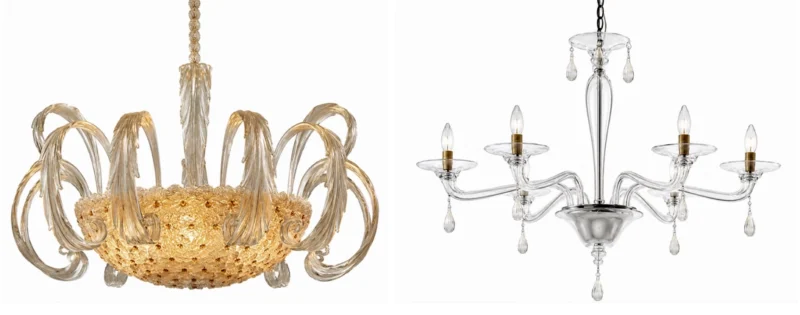
Murano glass chandeliers occupy the space between lighting and collectible art. Their hand-formed elements, expressive color, and organic silhouettes can introduce visual energy to an interior without the weight of metal or wood. In clear or pale glass, they appear luminous and ethereal. In amber, cobalt, rose, or smoke, they become the room’s defining color statement.
The most successful chandelier selections begin with scale. A fixture should feel substantial enough to command the room, but not so large that it overwhelms the architecture or obstructs sightlines. Ceiling height, room dimensions, furniture placement, and the chandelier’s visual density must all be considered together.
In a double-height foyer, a generously scaled chandelier can bring the volume down to a more human level. The suspended fixture occupies the otherwise empty vertical space and creates a visual connection between floors. In a dining room, its relationship to the table is more intimate. The chandelier should anchor the composition while allowing guests to see one another comfortably beneath it.
Living rooms offer greater flexibility. A chandelier may be centered over the primary seating arrangement rather than the room itself, particularly in open-plan interiors. This subtle shift helps define the conversation area and gives the furniture a stronger architectural framework.
Bedrooms, dressing rooms, and bathrooms can also benefit from antique lighting. A smaller chandelier over a freestanding bathtub or centered within a dressing room introduces unexpected glamour, although electrical ratings, ventilation, ceiling structure, and local installation codes must be carefully considered. Antique fixtures should always be inspected and, when necessary, rewired by a qualified professional before installation.
Light quality matters as much as form. The most beautiful chandelier can feel harsh if fitted with overly bright bulbs or placed on a single, inflexible circuit. Dimmers allow the fixture to move between functional illumination and atmospheric glow. In many interiors, the chandelier works best as one element within a layered lighting scheme that also includes sconces, table lamps, floor lamps, and discreet architectural lighting.
The room should not be designed around the chandelier in an overly literal way. Matching every metal finish or repeating its motifs throughout the space can diminish its impact. A more sophisticated approach allows the fixture to stand apart while maintaining a subtle relationship with the room’s palette and materials.
This is where antique lighting proves especially valuable. Because no two pieces age in precisely the same way, each brings a degree of individuality that is increasingly difficult to achieve through mass-produced design. A slight variation in glass, a softened gilded finish, or the irregularity of hand-carved wood becomes part of the interior’s character.
Huff Harrington’s collection, which spans centuries and includes French crystal, carved wood, crown-style fixtures, and Murano glass, reflects the breadth of expression available within antique lighting. The pieces demonstrate how dramatically a chandelier can alter the emotional temperature of a room from formal and luminous to warm, sculptural, or playfully decorative.
The chandelier is no longer the final accessory chosen after the major decisions have been made. In many of today’s most thoughtful interiors, it is the starting point. Its scale can influence furniture placement, its materials can guide the palette, and its quality of light can shape the atmosphere from morning through evening.
By drawing attention upward, antique chandeliers transform the ceiling from a forgotten plane into an essential part of the composition. The effect is architectural, atmospheric, and deeply personal. In a room designed to be remembered, the most powerful statement may be the one suspended overhead.
