

Barcelona is often introduced through a handful of unforgettable silhouettes: the rising towers of the Sagrada Família, the rippling stone façade of La Pedrera, and the almost aquatic curves of Casa Batlló. Antoni Gaudí’s presence is so powerful that it can appear to define the city entirely. Yet Barcelona’s architectural identity was never the work of one imagination.
The city is better understood as a collection of layers. Roman foundations survive beneath medieval streets. Gothic churches rise from tightly woven neighborhoods, while the rational geometry of the Eixample created the setting for the exuberance of Catalan Modernisme. Later generations used housing, museums, markets, public squares, and the waterfront to rethink how Barcelona should be experienced.
Before the city became synonymous with Modernisme, it was a compact medieval center enclosed by walls. The Barri Gòtic still preserves that sense of compression. Narrow passages open unexpectedly onto stone courtyards and small plazas, while fragments of Roman masonry appear within later façades. Barcelona Cathedral anchors the district, but Santa Maria del Mar offers a quieter kind of grandeur. Its broad nave, slender columns, and restrained interior create a remarkable sense of clarity, demonstrating how proportion and light can carry as much power as ornament.
Barcelona’s most consequential architectural achievement may not be a single building at all. In the 19th century, engineer Ildefons Cerdà proposed the expansion now known as the Eixample, organized around a vast grid of broad avenues, octagonal intersections, and interior courtyards. The plan was designed to improve light, ventilation, circulation, and public health while allowing the city to grow beyond its medieval boundaries.
The Eixample provided a disciplined urban framework, but its architecture became a field of extraordinary individual expression. Apartment façades compete for attention through carved stone, wrought iron, stained glass, ceramics, sculptural balconies, and elaborate entrances. The grid created order; ornament supplied identity.
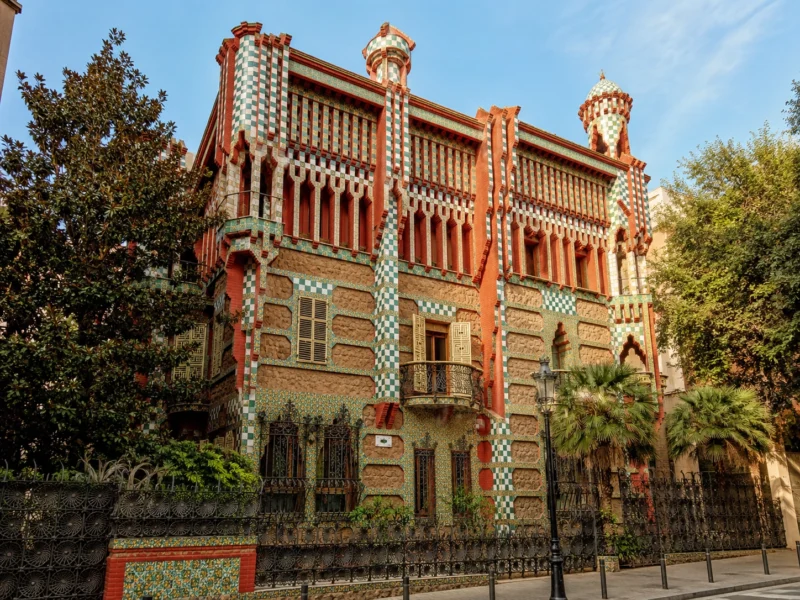
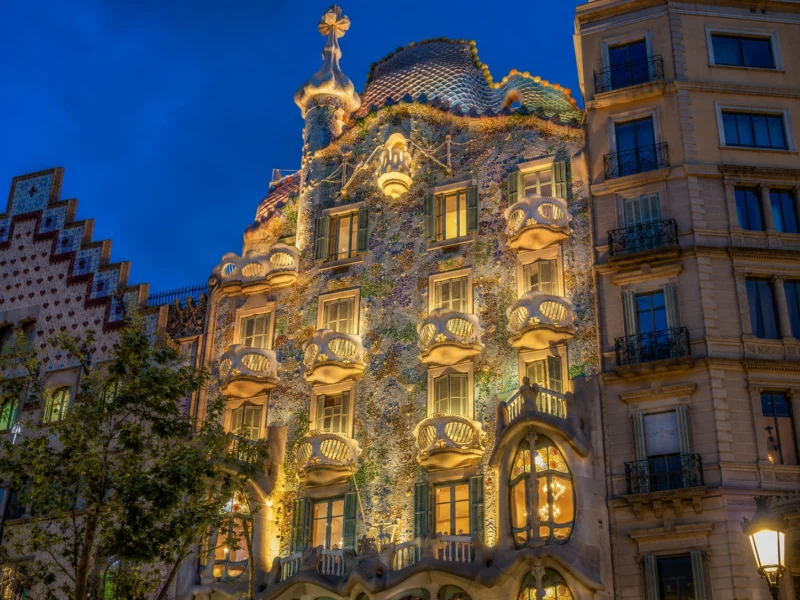
Within that framework, Gaudí produced buildings that continue to defy easy classification. Casa Batlló transforms an existing urban residence into a complete decorative environment, from its undulating façade to its light-filled interior. Casa Milà treats the corner block as a sculpted mass, replacing the traditional flat elevation with waves of stone and an extraordinary rooftop of chimneys and ventilation towers. Casa Vicens, completed earlier in his career, reveals a more geometric and polychromatic language through tile, brick, iron, and vivid color.
Gaudí’s achievement was not simply the creation of unusual forms. He dissolved the boundaries between architecture, furniture, structure, surface, and landscape. His buildings were designed to be entered, climbed, touched, and experienced from constantly changing angles.
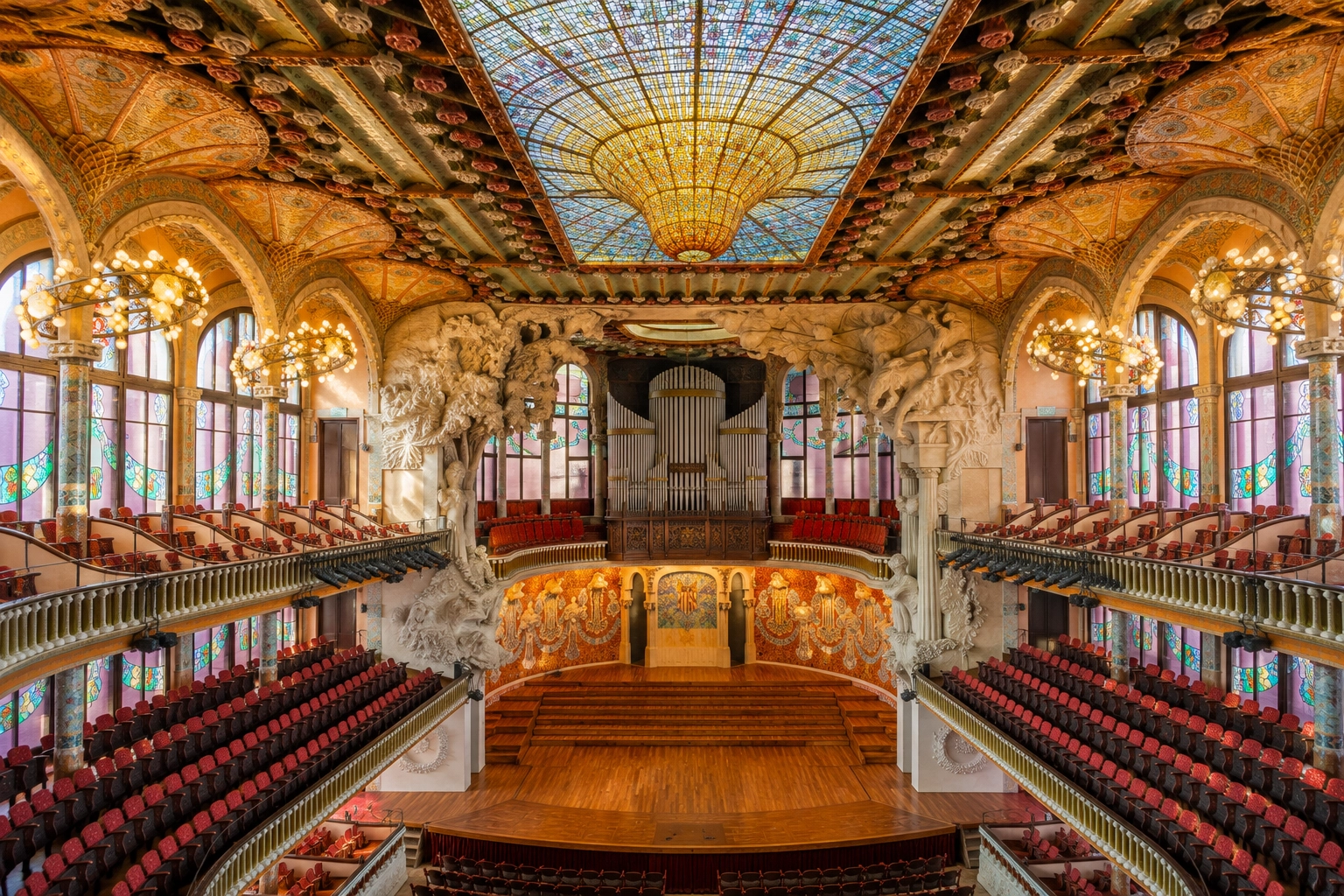
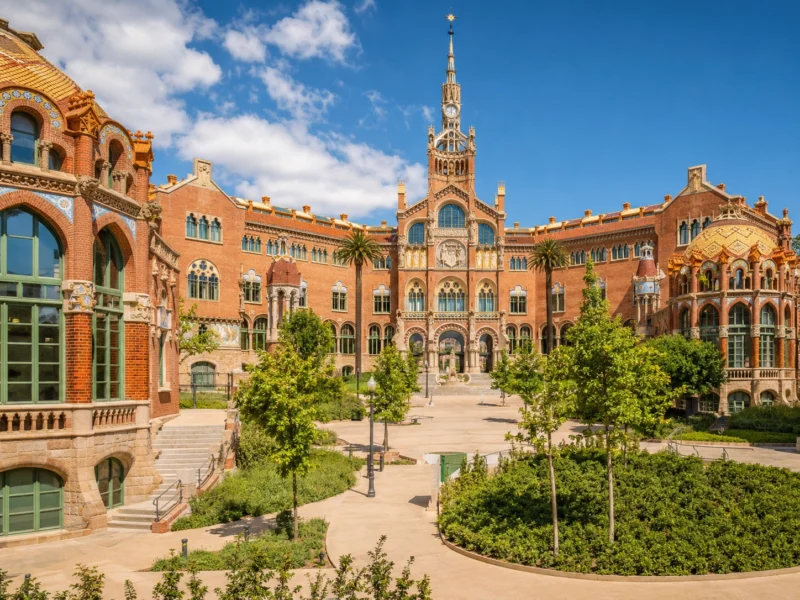
Yet Modernisme extended far beyond its most famous name. Lluís Domènech i Montaner gave the movement a more civic and theatrical dimension. At the Palau de la Música Catalana, steel, glass, ceramics, mosaics, sculpture, and stained glass come together in an interior that seems illuminated from within. At the Hospital de Sant Pau, he organized a medical complex as a series of richly detailed pavilions connected by landscaped gardens and underground passages, turning light, air, color, and nature into elements of healing.
Josep Puig i Cadafalch brought another sensibility to the movement. Casa Amatller, standing beside Casa Batlló on the celebrated Block of Discord, combines Gothic references, a stepped gable, ceramic ornament, sculptural detail, and finely crafted interiors. Together, these architects transformed Barcelona into a city where concert halls, homes, hospitals, workshops, and shops could be conceived as total works of art.
A few decades later, the Barcelona Pavilion introduced an entirely different expression of luxury, anticipating the modernist principles that would reshape architecture and design worldwide. Designed by Ludwig Mies van der Rohe and Lilly Reich for the 1929 International Exposition, it replaced ornament with proportion, reflection, and exceptional materials. Slender columns support a floating roof, while planes of glass, travertine, marble, and onyx define spaces without fully enclosing them. Its apparent simplicity is carefully choreographed, proving that architectural richness can come from restraint as readily as decoration.
Barcelona’s architecture changed again in the years leading up to the 1992 Olympic Games. The redevelopment of the waterfront introduced beaches, housing, parks, roads, sporting facilities, and a renewed relationship with the Mediterranean. The transformation was not limited to a group of landmarks; it altered how residents moved through the city and established public space as one of Barcelona’s defining design instruments.
Contemporary architecture has continued this process of reinvention. The Mercat de Santa Caterina, redesigned by Enric Miralles and Benedetta Tagliabue, is crowned by an undulating mosaic roof that announces the market without erasing the older structure below. Richard Meier’s MACBA introduced luminous white geometry into the dense fabric of El Raval, while its surrounding plaza developed a civic life of its own.
Barcelona is compelling because its architecture never settles into one language. Roman stone, Gothic verticality, Modernista ornament, modernist restraint, industrial reuse, and Olympic urbanism coexist within a remarkably walkable city. To see Barcelona only through Gaudí is to see brilliance without context. His buildings become even more powerful when placed within the larger architectural culture that made them possible.
Among the world’s most compelling architectural destinations, Barcelona offers the rare ability to move through centuries of design in the space of a morning.
