

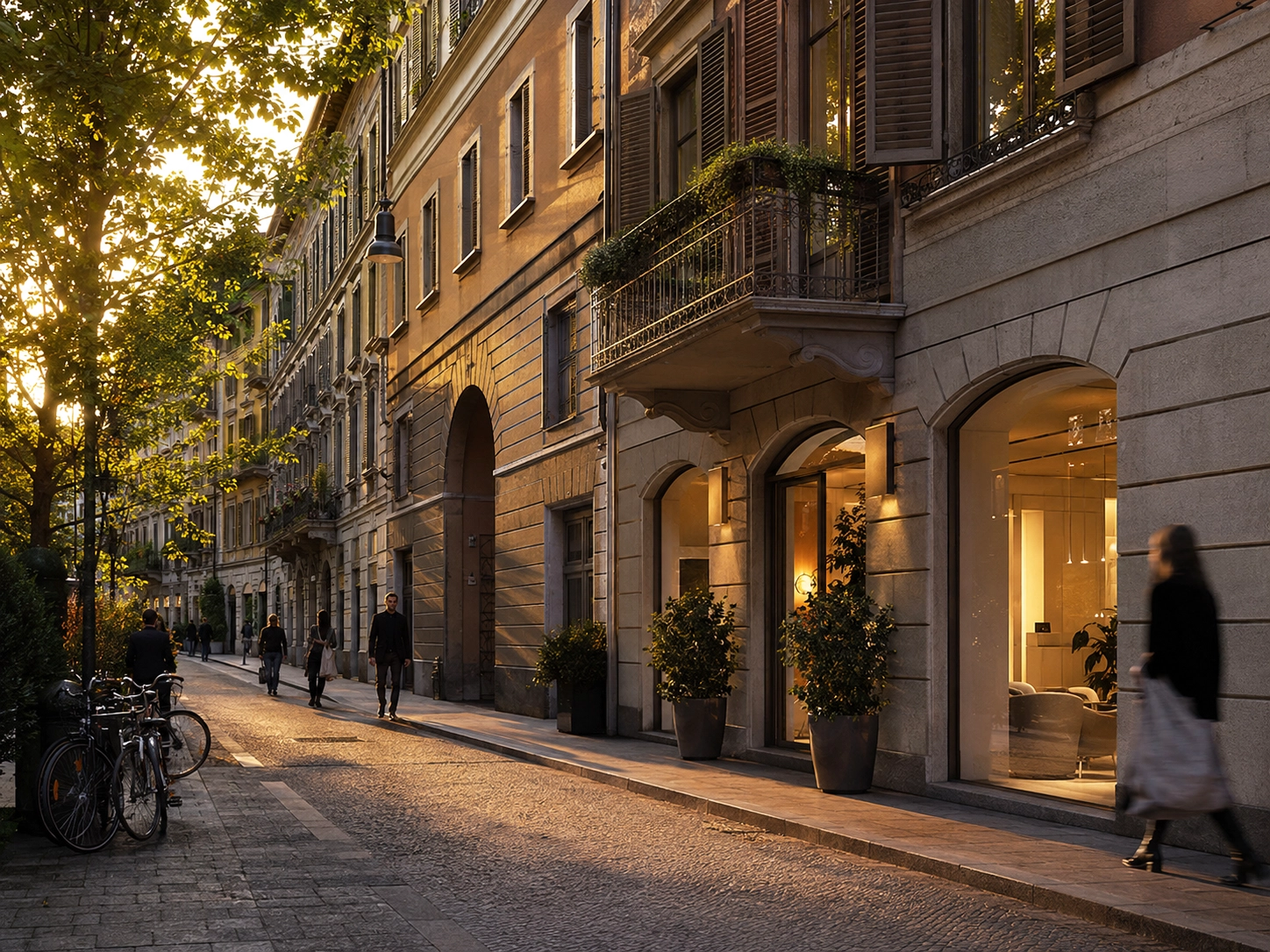
A heavy wooden door opens on a quiet street in Brera, and the city changes.
Beyond the stone façade, the traffic recedes. A courtyard appears, cool and shadowed, framed by pale stucco, wrought-iron balconies, and climbing greenery. Somewhere above, a window stands open. Inside, a contemporary lamp glows against a frescoed ceiling, and a sculptural chair sits on a floor that has been polished by generations of footsteps.
This is how Milan often reveals itself: not all at once, but through thresholds.
The city’s design authority has never depended solely on spectacle. It lives behind closed doors, in private palazzi, restrained apartments, former factories, and galleries where a radical piece of furniture may be positioned beside a Renaissance column without apology. Milan understands that design does not need to erase history to feel contemporary. It can enter an old room, alter the atmosphere, and allow the architecture to remain fully itself.
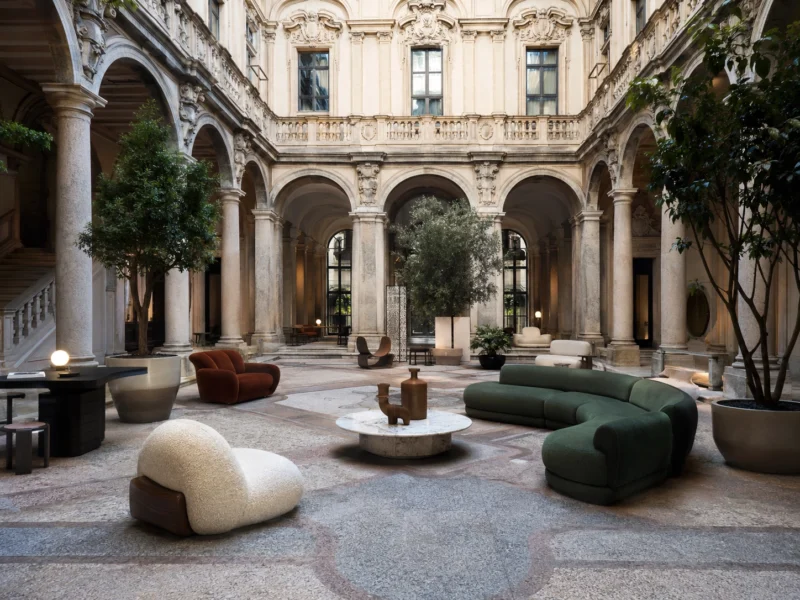
Each spring, Salone del Mobile brings the international design world into the city, filling showrooms, courtyards, warehouses, and temporary installations with new work. Yet Milan’s most persuasive design experiences often begin after the fairgrounds close. They are found in permanent spaces where furniture, art, architecture, and daily life have been layered over time.
Brera offers the clearest introduction to that sensibility. Its streets possess an almost cinematic balance of refinement and understatement: ochre façades, tall shutters, discreet brass plaques, and windows that reveal only fragments of what lies within. There is rarely a single visual declaration. Instead, the district builds character through accumulation.
A gallery may occupy rooms with elaborate cornices and muted plaster walls. A lighting showroom may open onto a courtyard planted with boxwood and olive trees. A polished marble threshold may lead into an interior where new furniture is arranged with the intimacy of a private home rather than the logic of retail.
That sense of domesticity is essential to Milanese design. Objects are rarely allowed to float in isolation. They are placed in relation to architecture, art, and human ritual. A chair is considered beside a window. A table is judged by the space it creates around it. Lighting is used not simply to illuminate, but to soften scale and deepen atmosphere.
At Villa Necchi Campiglio, this relationship between architecture and daily life is rendered with extraordinary precision. Designed by Piero Portaluppi in the 1930s, the house remains one of Milan’s most complete portraits of cultivated modernity.
Its materials are luxurious, but never indiscriminate. Veined stone, dark timber, polished metal, and tailored upholstery are composed with almost mathematical restraint. Rooms open into one another with a measured rhythm, while large windows frame the garden as carefully as paintings.
The famous swimming pool, set into the grounds with striking simplicity, feels less like an amenity than an architectural gesture. Inside, the winter garden brings greenery and filtered light into the house, softening the rigor of the plan. There is glamour, certainly, but it is held in check by proportion.
This may be one of Milan’s enduring lessons: luxury is most convincing when it appears inevitable.
The city’s modernism was rarely cold. Even its most disciplined interiors retained a sensual understanding of material. Wood was allowed to appear warm and deep. Stone was chosen for movement and grain. Upholstery softened geometry rather than disguising it. The result was an elegance that felt precise without becoming inhospitable.
That same balance continues in Milan’s contemporary galleries and cultural spaces.
At Nilufar, collectible design is presented with theatrical confidence. Historic furniture and contemporary pieces are placed together not according to chronology, but according to instinct. A modernist chair may sit beneath an experimental suspension light. A lacquered cabinet may be paired with a rough ceramic vessel or an abstract textile.
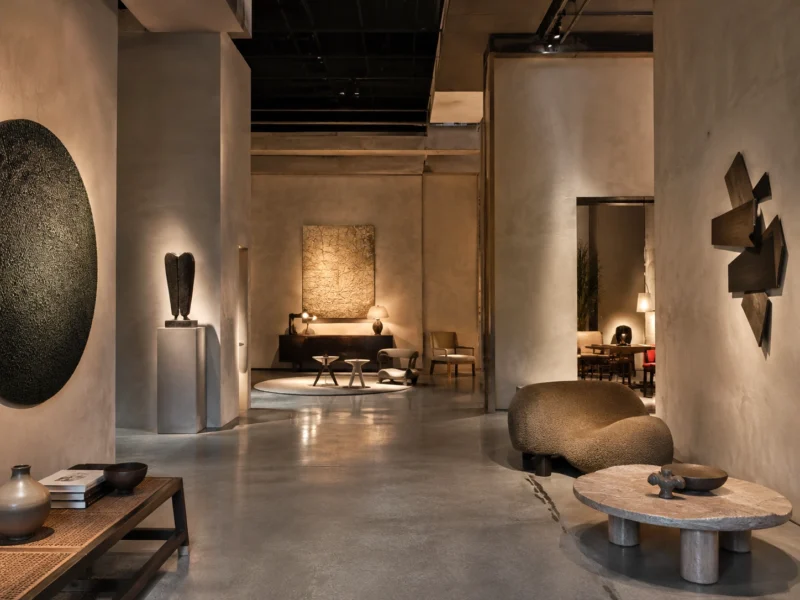
The arrangements create tension without chaos. Each object is given enough space to retain its identity, yet the groupings encourage comparison across periods, materials, and schools of thought. The effect is less like visiting a conventional showroom than entering the mind of an exacting collector.
Nilufar Depot expands this idea on a larger scale. Within its industrial volume, furniture becomes architecture. Platforms, sight lines, and dramatic shifts in height transform the building into a series of immersive rooms. Pieces are not simply displayed; they are staged, allowing texture, silhouette, and proportion to register from a distance.
Elsewhere, Fondazione Prada demonstrates Milan’s gift for reinvention through contrast. The former industrial complex does not hide its past beneath a seamless renovation. Brick, concrete, mirrored surfaces, and contemporary interventions coexist visibly, creating an environment in which old and new remain in productive tension.
The gold-clad Haunted House catches the light with deliberate extravagance, yet it sits within a setting defined by industrial austerity. That juxtaposition gives the complex its charge. Nothing is resolved too neatly. The visitor moves between compression and openness, darkness and reflection, roughness and polish.
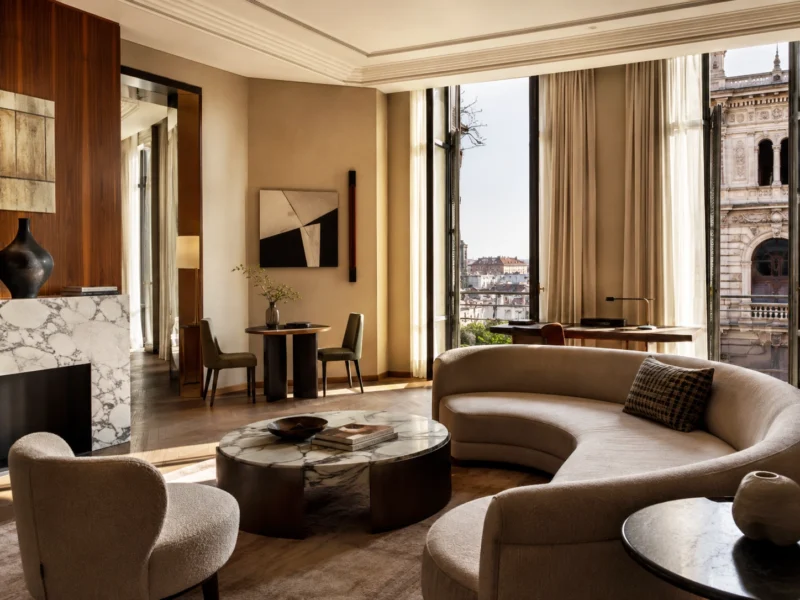
This tension between discipline and sensuality also shapes Milan’s hotels, restaurants, and private interiors. Rooms often combine materials that could easily become excessive—marble, brass, lacquer, velvet, dark wood—but are controlled through proportion and lighting.
A curved sofa may soften a paneled wall. A low table in stone may anchor a room filled with art. Curtains are often generous, lighting is warm and directional, and the palette is allowed to deepen toward evening. Even grand spaces are arranged to create intimacy.
The city’s interiors rarely announce themselves through a single trend. Their authority comes from editing. Nothing feels accidental, but neither does the room appear overly composed. The finest examples retain a sense of life: a book left open, flowers arranged loosely, a chair angled slightly away from the expected symmetry.
Milan is also a city of concealed gardens and internal courtyards, spaces that blur the line between architecture and landscape. From the street, a building may appear severe. Inside, the same structure opens toward trees, stone paving, water, and filtered sunlight.
This movement from restraint to abundance is one of the city’s most seductive qualities. It rewards curiosity. Milan does not give everything to the passerby; it invites discovery.
Perhaps that is why its influence remains so durable. The city does not treat design as a collection of objects, nor as a seasonal event. It understands design as a sequence of relationships: between old and new, public and private, architecture and furniture, rigor and comfort.
Beyond the showrooms, Milan’s true design culture lives in these quieter exchanges. It appears in the weight of a door handle, the curve of a staircase, the shadow beneath a cornice, and the way a single chair can alter the balance of an entire room.
The city’s beauty is not hidden, exactly. It is simply waiting behind the next door.
