

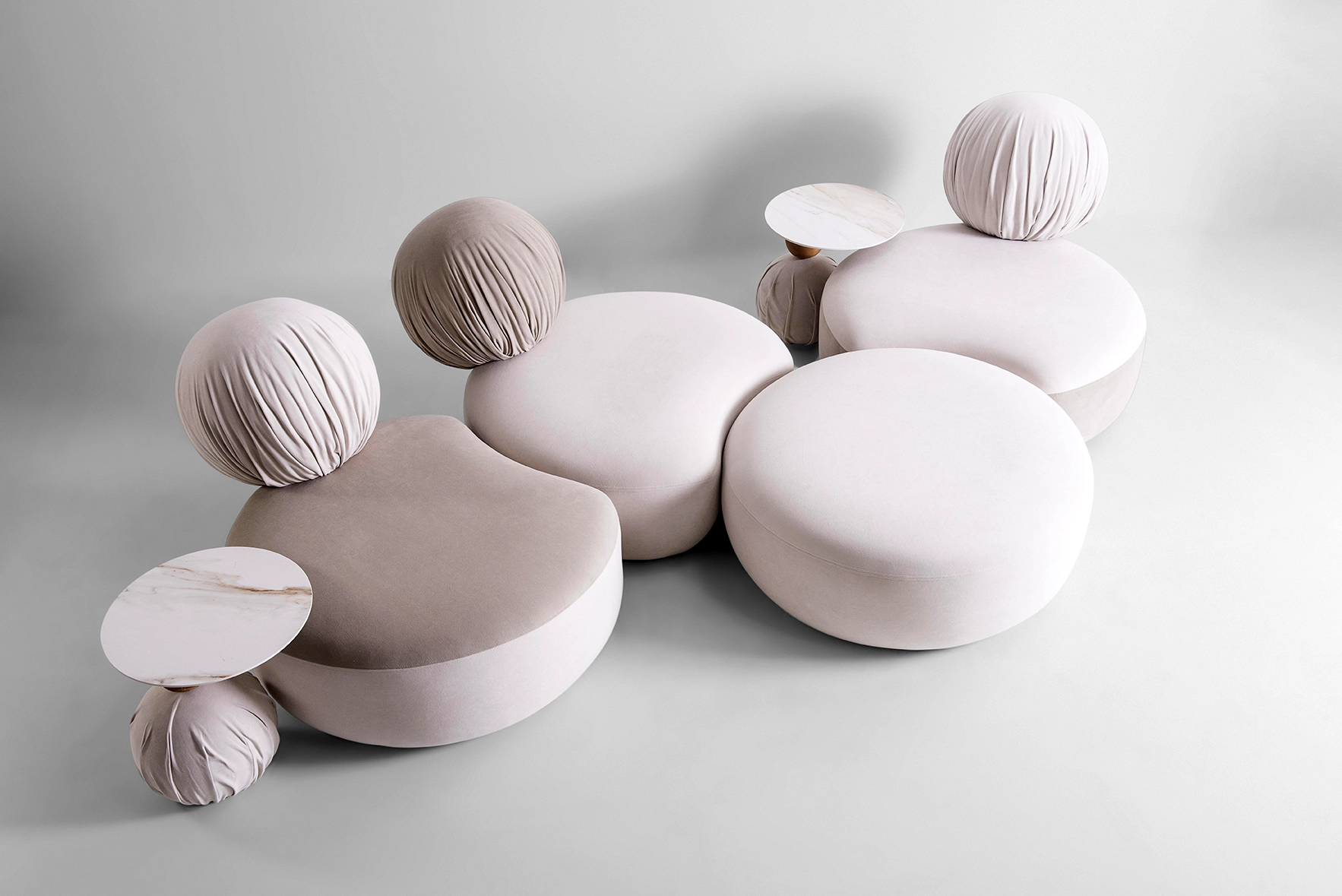
At first glance, Ginga appears composed and almost architectural. Its low, linear base is articulated by disciplined horizontal seams, while a rounded backrest rises from the structure with a softer, more instinctive presence. Look longer, however, and the sofa begins to suggest movement: an object designed not as a fixed arrangement, but as a composition in constant negotiation with the room around it.
Created by Brazilian architect and designer Anna Maya, Ginga made its international debut at Salone del Mobile. Milano within the Brazilian Furniture presentation organized by Abimóvel and ApexBrasil. Its name comes from the fluid, oscillating step at the foundation of capoeira, the Brazilian martial art that developed through a complex meeting of African, Indigenous, and European cultural traditions.
In capoeira, the ginga is not simply a movement performed between attacks. It is the perpetual motion that keeps the body alert, balanced, and ready to adapt. Weight shifts from one foot to the other. The stance appears relaxed but remains intentional, creating an equilibrium between stability and transformation.
Maya translates that principle into furniture through a modular system that can be rotated, rearranged, and expanded. Individual components are designed to form multiple configurations, allowing the sofa to change with the architecture, the occasion, or the people using it. Rather than dictating a single way of inhabiting a room, Ginga creates a framework for different relationships to emerge.
The concept feels particularly relevant at a time when the traditional living room is being reconsidered. Contemporary interiors increasingly serve several functions at once, shifting between private retreat, social gathering place, and informal workspace. Furniture that remains rigidly arranged can quickly feel out of step with that reality. Ginga’s modularity offers a more responsive proposition, one in which the seating evolves rather than merely occupies space.
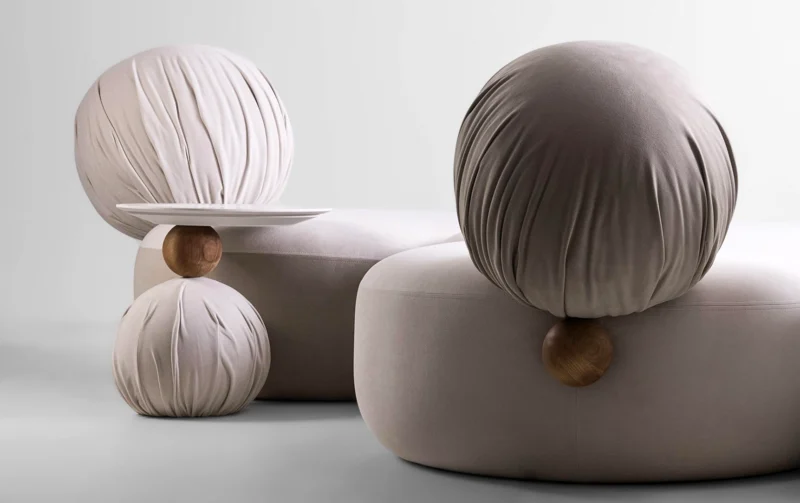
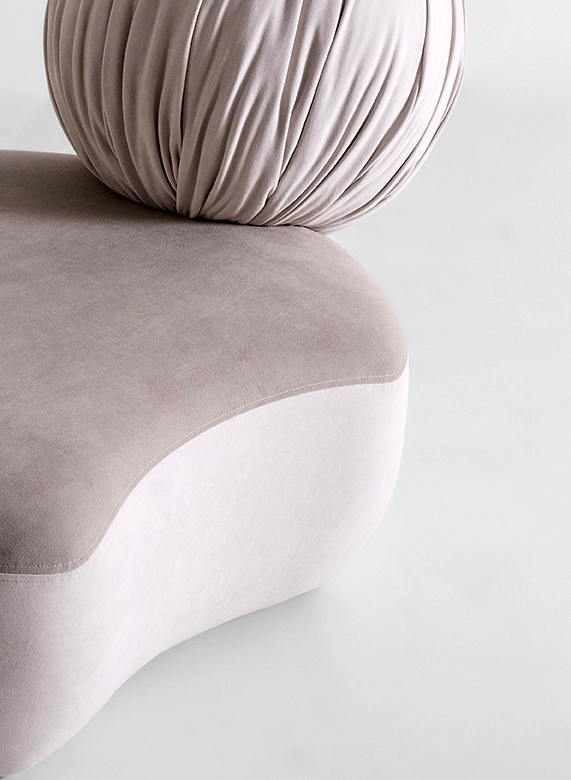
Its flexibility, however, does not come at the expense of formal clarity. The base is developed through a sequence of clean horizontal lines that establish proportion and visual rhythm. Seams divide the upholstered volumes with precision, creating a graphic framework that can accommodate contrasting fabrics, colors, and textures. The effect is ordered without appearing severe.
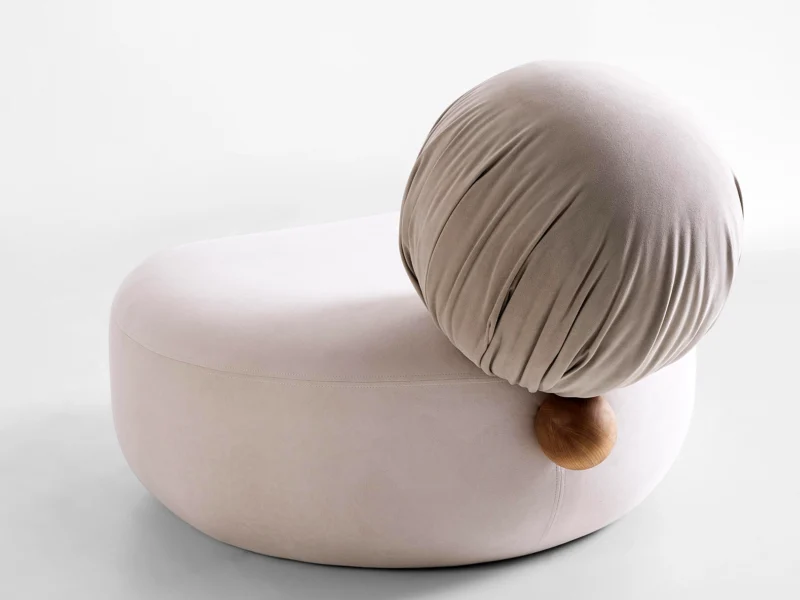
Against that linear structure, the rounded backrest introduces a deliberate tension. Its gathered upholstery creates a tactile, almost sculptural surface, softening the geometry of the base and giving the sofa its most recognizable gesture. From behind, a vertical seam draws the eye toward a small wooden sphere, positioned like a punctuation mark at the end of a sentence.
The sphere is more than a decorative flourish. It appears repeatedly throughout Maya’s work and has become part of her visual vocabulary. Pure geometries, particularly circular and spherical forms, allow her to explore balance, perception, and movement without relying on overt ornament.
That approach places Ginga in quiet conversation with Brazilian modernism, a tradition in which geometry has rarely been treated as cold or static. From the sweeping curves of Oscar Niemeyer’s architecture to the sensorial furniture of Lina Bo Bardi and Sérgio Rodrigues, Brazilian design has often found ways to bring structure and sensuality into the same frame.
Maya’s interpretation is distinctly her own. Rather than borrowing familiar tropical motifs or leaning into an expected palette, she draws on movement as a cultural idea. The reference to Brazil is embedded in the sofa’s behavior and composition rather than applied to its surface.
This distinction gives Ginga much of its intelligence. It does not attempt to illustrate capoeira literally. Instead, it translates its underlying principles—balance, readiness, improvisation, and continuous adjustment—into a contemporary language of upholstery and form.
The project also reflects a broader shift in how cultural identity appears in design. Increasingly, the most compelling objects are those that move beyond symbolism and engage with deeper systems of thought. In Ginga, culture is not presented as ornament or nostalgia. It becomes a method of organizing space.
Sustainability has been incorporated through a similarly practical lens. According to the designer, the sofa uses certified wood, renewable upholstery materials, and production methods intended to reduce textile waste. Its modular construction also supports longevity, since the components can be reorganized rather than discarded when spatial needs change.
Durability has become one of the more persuasive measures of sustainable furniture design. Materials matter, but so does the ability of an object to remain useful and desirable over time. A sofa that can adapt to a new residence, a different room, or an evolving household may ultimately have a longer life than one designed around a single fixed configuration.
Maya brings nearly three decades of experience in architecture and interior design to the project. Based in Florianópolis, she has increasingly extended her practice into furniture and product design, developing a formal language built around pure volumes, precise construction, and sensory detail.
Her work has received international recognition from the A’ Design Award, the MUSE Design Awards, and the Prémio Lusófonos de Arquitetura e Design de Interiores. In 2026, she also received an iF Design Award, further strengthening her position within Brazil’s contemporary design landscape.
Yet Ginga’s appeal lies less in its collection of accolades than in the clarity of its central idea. It succeeds because its cultural reference and physical function are inseparable. The sofa moves because the concept demands movement. Its geometry is precise because balance requires structure, while its curved surfaces prevent that structure from becoming rigid.
In that dialogue between discipline and spontaneity, Maya captures something distinctly Brazilian without resorting to the expected. Ginga is not a portrait of Brazil frozen in form. It is Brazil understood as rhythm: adaptable, expressive, and always in motion.
