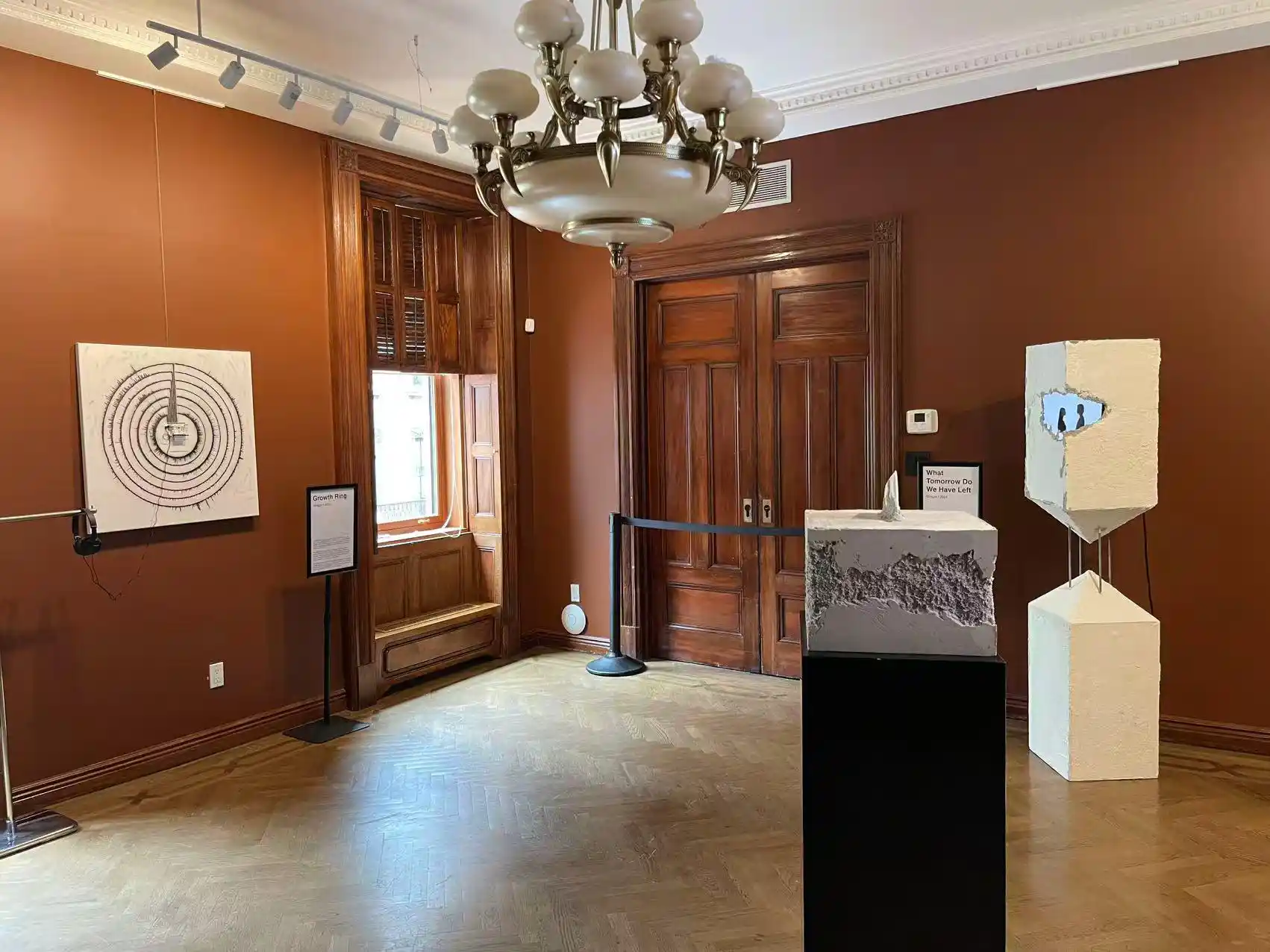
There’s nothing in New Sprouts that asks for your attention right away. Mingze Gao’s solo exhibition at the New York Memor Museum doesn’t announce itself with scale or spectacle. It doesn’t explain itself either. Instead, it waits. The works sit quietly, almost cautiously, as if they’re aware that growth, real growth, rarely happens on a schedule. Presented during the 3rd Annual Madison Avenue Design Week as part of the NYCxDESIGN Festival, New Sprouts revolves around a simple but difficult idea: that becoming is ongoing, uneven, and often invisible while it’s happening. Gao isn’t interested in breakthroughs or clean turning points. What he shows instead is how identity forms through repetition, memory, and time passing without ceremony. The exhibition’s title gestures toward beginnings, but it never treats beginnings as clean slates. New sprouts don’t emerge out of nowhere. They grow from what’s already there. That logic runs through the entire show.
One of the most engaging works, “Growth Ring”, makes this idea physical. The installation takes inspiration from tree rings, natural records of time that expand outward, layer by layer, shaped by environment rather than intention. Gao translates this into an interactive sound piece using conductive paint and embedded circuitry on canvas. Visitors wear headphones and activate different sounds by touching curved sections of a visualized sound wave. There are seven sound environments in total, each loosely corresponding to a life stage. Some are intimate, like muffled heartbeats. Others feel ordinary: footsteps, the sound of unwrapping cheap fruit candy, subway noise. None of them comes with instructions on how they should feel. That’s intentional. The piece doesn’t tell a story so much as it creates space for one. People tend to linger here, touching and re-touching sections, listening again. It feels less like moving forward and more like circling back.

If “Growth Ring” brings memory outward through sound, “Dear Fayerbanke” feels like something held back. The sculpture began as an imagined letter, addressed to something or someone deliberately unclear. The title suggests closeness and distance at the same time. It’s not obvious whether the letter was ever meant to be sent. The work draws from Gao’s engagement with the writing of Shi Tiesheng, particularly his reflections on memories that resist language. These are not memories you recount easily. They don’t arrive as stories. They exist as sensations, loneliness, warmth, and longing, stored somewhere deeper than words. Dear Fayerbanke gives form to that kind of remembering. It’s quiet, almost guarded. In the context of New Sprouts, it suggests that growth doesn’t require explanation. Some changes stay internal, shaping us without ever being articulated.
Time becomes more unsettled in “What Tomorrow Do We Have Left”, a video installation built as a fractured hourglass. The structure is made from plaster, birch plywood, and metal pipes, and inside it, a digital screen loops video footage continuously. The hourglass, usually a symbol of time moving forward, is broken here. Time doesn’t fall cleanly from past to future. It pauses. It repeats. There’s something vulnerable about this work. It feels less like a statement and more like a confession. The looping screen suggests being stuck, waiting for something that doesn’t arrive, while the physical materials feel fragile, almost temporary. Gao has described the piece as a kind of self-portrait, and that feels right. It captures the experience of facing a future that feels suspended rather than lost. What ties New Sprouts together isn’t a single message or visual language, but restraint. Gao works carefully. Even when dealing with big ideas—time, memory, identity—he resists overloading the viewer. The materials are modest. The gestures are controlled. Nothing feels rushed. That restraint mirrors the exhibition’s core belief: growth doesn’t announce itself. It accumulates.

By the time you leave New Sprouts, you may not feel transformed. That’s the point. The exhibition doesn’t aim for impact in the obvious sense. It trusts that something quieter is happening instead, something closer to how change actually works. Slowly. Unevenly. And often without us noticing until much later. Ultimately, New Sprouts does not try to resolve the questions it raises. It accepts uncertainty as part of becoming. By allowing memory, time, and identity to remain open-ended, Mingze Gao offers a rare kind of honesty. The exhibition reminds us that growth is not something we arrive at, but something we carry forward, often without realizing how much has already changed.