

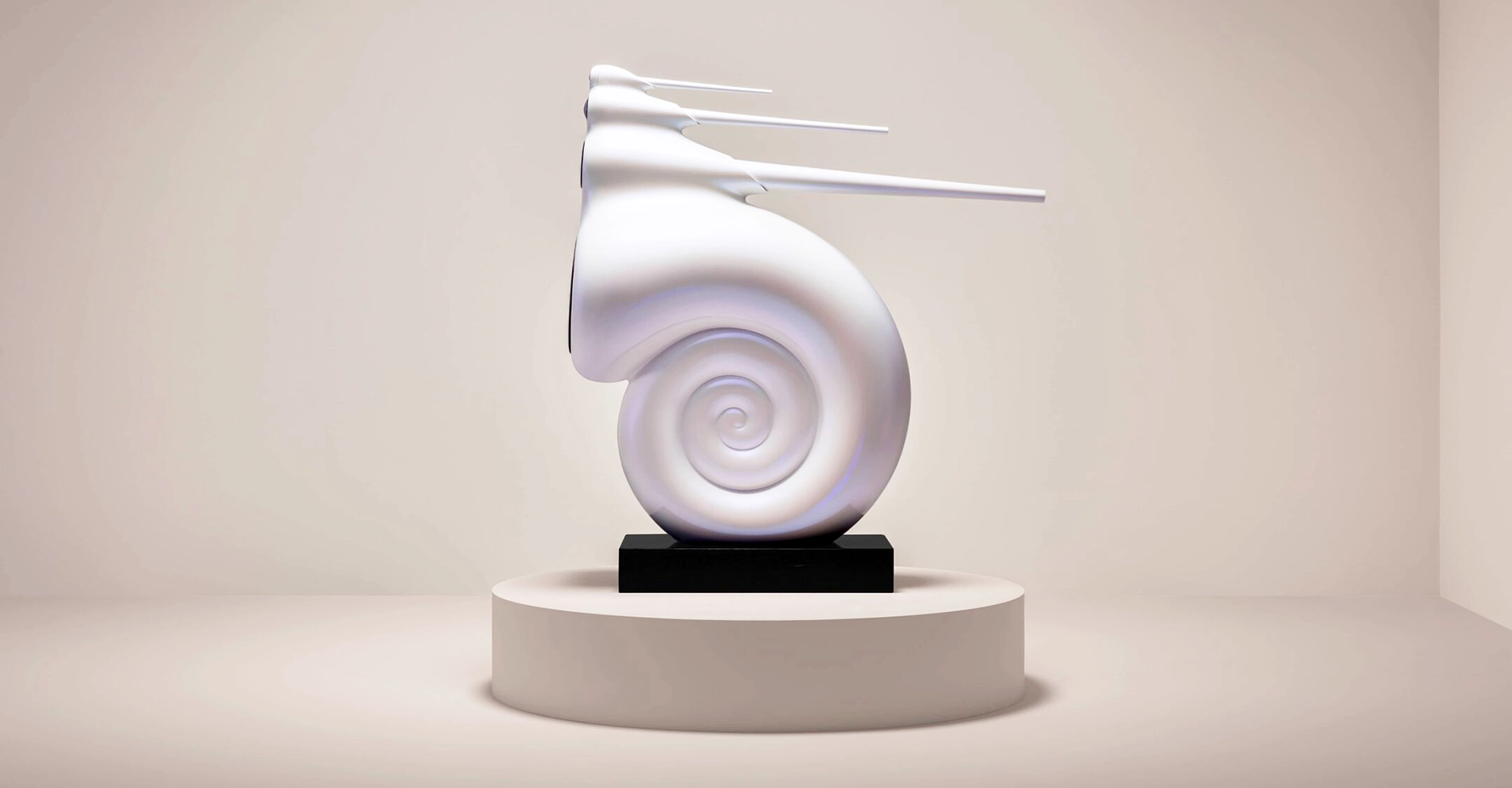
More than three decades after its debut, the Bowers & Wilkins Nautilus is still finished as an exceptional piece of collectible design should be: slowly, meticulously, and by hand. At the company’s Worthing facility in England, each sculptural cabinet receives 12 layers of paint and lacquer, building depth across the curves first revealed to the world in 1993.
That process feels increasingly unusual in an age of rapid production and planned replacement. The Nautilus follows a more enduring philosophy, one in which acoustic research, specialist craftsmanship, and visual identity are treated as inseparable parts of the same object.
Its familiar spiral form was never conceived merely to attract attention. The design emerged from an ambitious investigation into what happens to sound energy behind a loudspeaker driver, and how that unwanted energy might be absorbed before it returns through the cone and colors the music.
Bowers & Wilkins developed a system of long, tapered damping tubes behind the individual drive units. These channels allow excess acoustic energy to dissipate gradually, reducing internal reflections and helping the drivers operate with greater accuracy. The bass driver required a tube of considerable length, so the enclosure was curled into the spiral that now defines the Nautilus.
What appears organic is therefore deeply technical. The speaker may resemble a marine shell, a monumental snail, or an artifact from an imagined future, yet its silhouette is the physical expression of an acoustic solution rather than styling applied after the engineering was complete.
That distinction explains why the Nautilus still looks contemporary. Many objects celebrated as design icons survive because nostalgia has made them desirable again. The Nautilus never truly left the future, because its form was shaped by function rather than by the decorative conventions of its decade.
The speaker’s construction remains correspondingly demanding. Its cabinet is assembled from separate molded sections that must be joined and carefully worked until the transitions effectively disappear. On a form defined by continuous curves and sweeping reflections, even a slight seam would interrupt the visual flow.
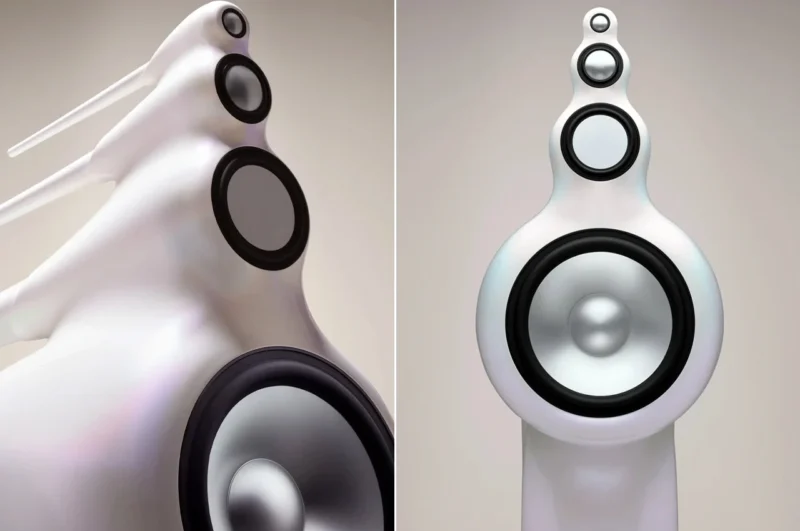
The surface is repeatedly refined before the finishing process begins. Paint and lacquer are then sprayed by hand in successive coats, each one contributing to the final depth, clarity, and uniformity of the color. The process cannot be meaningfully hurried, because every layer affects the way light travels across the shell.
Once the 12 coats have been applied, polishing draws out the high-gloss finish for which the Nautilus is known. The result is not simply a colored enclosure, but a surface with visual dimension one that changes subtly as daylight moves through a room and reflections travel along its contours.
Bowers & Wilkins offers the Nautilus in established finishes including Midnight Blue, Black, and Silver. Each alters the character of the design: Black emphasizes its silhouette, Silver gives it a more technological presence, and Midnight Blue strengthens the relationship between the speaker and its marine inspiration.
Bespoke color matching extends that conversation into the interior itself. A commissioned pair can be developed around a supplied color reference, allowing the speakers to complement lacquered cabinetry, echo a collector car, introduce a saturated accent, or sit quietly within a restrained architectural palette.
That flexibility is important because the Nautilus was never intended to disappear. Conventional loudspeakers are often positioned reluctantly, accepted for their performance but visually softened, concealed, or pushed toward the edge of the room. Nautilus asks to be treated more like freestanding sculpture.
A pair can anchor a dedicated listening room, occupy a double-height salon, or hold the end of a long architectural sight line. Its presence is substantial, but its curves keep it from appearing heavy, while the tapering tubes create a sense of movement even when the speakers are silent.
The visual theatre does not diminish the seriousness of the audio system. Each drive unit operates within its own tapered enclosure, and the four-way configuration separates the frequency range across dedicated bass, lower-midrange, upper-midrange, and high-frequency drivers. The speakers require external active crossovers and multiple channels of amplification, underscoring that this remains a reference-level audio system rather than a sculpture with sound added.
That technical complexity is delivered without obvious aggression. The Nautilus does not rely on exposed machinery, flashing interfaces, or digital spectacle to communicate performance. Its sophistication lies largely beneath the surface, leaving the final form calm, polished, and almost elemental.
Its continued production is perhaps the clearest measure of its success. The Nautilus has endured not because it has been repeatedly redesigned to follow changing tastes, but because the original idea remains persuasive: remove unwanted sound, shape the enclosure around that pursuit, and finish the result with the care normally associated with a handcrafted object.
There is something quietly radical about a product that has not been simplified into a faster version of itself. The curves remain difficult to manufacture, the preparation remains labor-intensive, and the finish still depends on trained hands rather than an entirely automated sequence.
That refusal to rush is visible before the first note is played. Light gathers in the lacquer, travels across the shell, and reveals the precision beneath what initially appears effortless. The beauty comes not from hiding the work, but from refining it until the work becomes almost invisible.
The Bowers & Wilkins Nautilus was shaped by sound, yet its lasting allure comes from the meeting of engineering and touch. More than 30 years after its introduction, it remains proof that advanced technology need not look temporary and that the most futuristic objects are sometimes those made with the greatest patience.
